 GOVERNMENT OF INDIA

प्रारंभ तिथि
03/09/2026 - 18:00
अंतिम तिथि
30/09/2026 - 23:45
Time zone: IST (GMT +5.30 Hrs)
Created : 3/09/2026
279
Total Comments
210
Users Participated
Artificial Intelligence and Semiconductors are shaping the technological development landscape. As AI applications continue to expand, new possibilities are emerging across areas such as chip design, computing, manufacturing and advanced technologies.
Share your ideas and perspectives on the evolving landscape of AI and Semiconductors.
What new possibilities, ideas and innovations can emerge at the intersection of these technologies?
What new possibilities can emerge from AI and Semiconductor technologies?

1 week ago
1. Objective:
To strengthen India’s semiconductor ecosystem by integrating Artificial Intelligence (AI) in microchip design, quality control, and predictive maintenance.
2. Key Proposal:
AI-Optimized Chip Design: Use AI algorithms to speed up semiconductor layout design, reducing power consumption and increasing chip performance.
Smart Manufacturing: Implement computer vision and AI sensors in semiconductor fabrication units (Fabs) to detect silicon wafer defects early and reduce production waste.
Skill Development: Integrate AI and Semiconductor design modules into vocational and ITI training programs to build a skilled workforce for India's growing electronics ecosystem.
3. Impact on India:
This approach supports the 'India Semiconductor Mission' and 'Make in India', reducing dependence on chip imports and positioning Bharat as a global tech hub. Jai Hind!

1 week ago
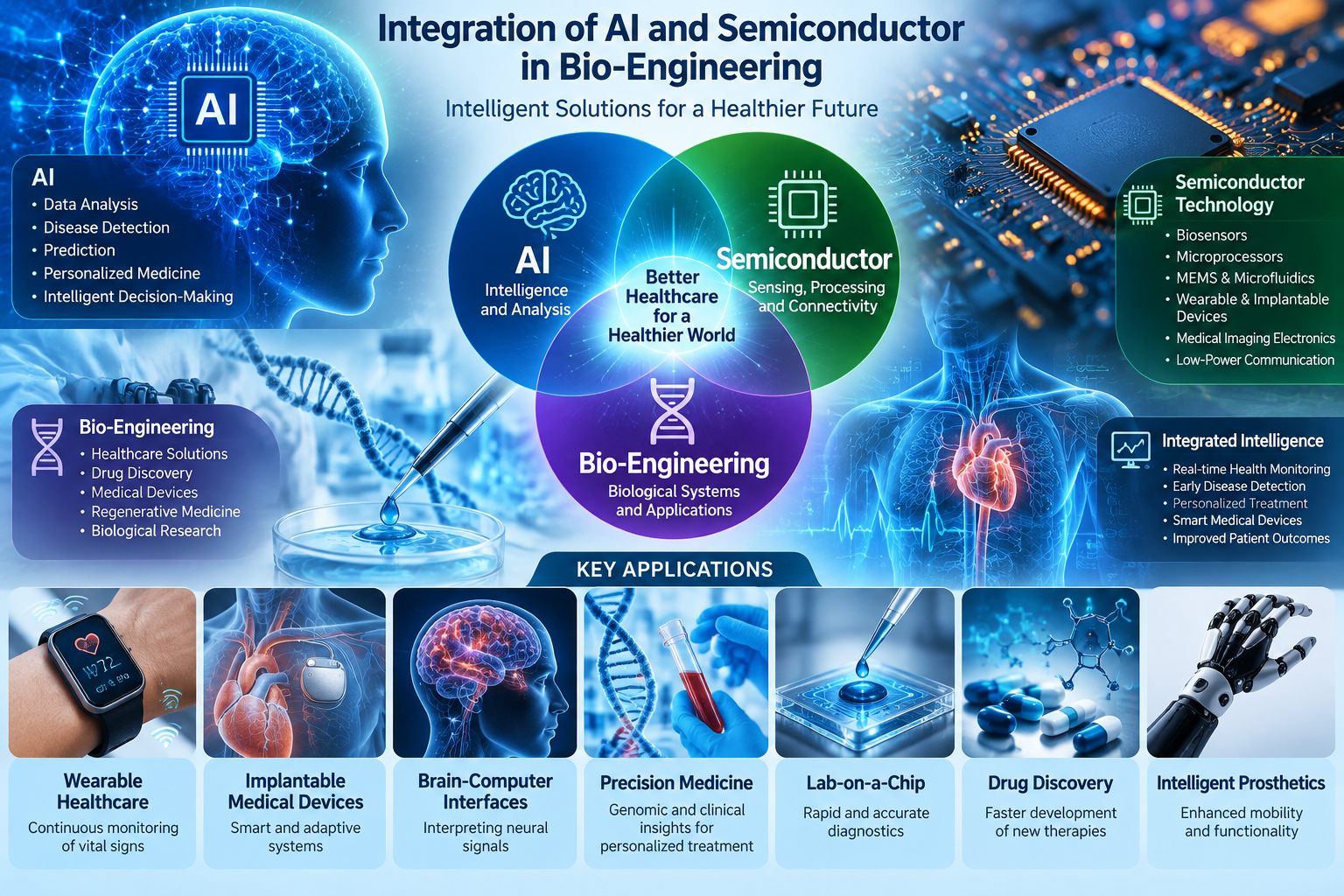
Hi. I am founder of Devine Technologies(VisualDevine AIResCom LLP). The integration of Artificial Intelligence (AI) and semiconductor technology with bio-engineering is transforming healthcare and biotechnology. Advanced semiconductor devices provide miniaturized sensors, processors, and communication systems capable of continuously monitoring biological signals. AI algorithms can analyze this data to detect diseases, predict health conditions, support personalized medicine, and improve medical decision-making. This combination enables smart wearable devices, implantable medical systems, brain-computer interfaces, lab-on-a-chip platforms, and intelligent prosthetics. AI-enabled semiconductor systems can process biological information rapidly and efficiently, enabling real-time responses. Together, AI and semiconductor technologies are creating intelligent, precise, efficient, and personalized solutions for future bio-engineering applications.

1 week ago
Responsible Use of AI and Semiconductors: AI Should Help Humans, Not Replace Them
AI and semiconductor technology can help India grow and create new opportunities, but they should always remain under meaningful human control. AI should mainly be used where it is truly necessary, especially for emergency situations, dangerous tasks, disasters, and work that is extremely difficult for humans.
AI should not be used unnecessarily for every small task. In fields like teaching, healthcare, law, creative work and management, humans should remain at the centre. AI can support people by saving time and effort, but it should not unnecessarily replace human jobs.
Students and workers should be taught how to use AI responsibly. Free training and reskilling should be provided so that people can stay capable and independent in a changing job market. Human skills such as critical thinking, creativity, communication and problem-solving should remain important.

1 week ago
Developing a new microchip layout manually takes teams of engineers years due to the trillions of possible transistor placements. AI algorithms (specifically reinforcement learning) can optimize chip floorplanning, routing, and thermal distribution in days instead of months, finding optimal configurations that human designers might never discover.
Large language models consume massive amounts of electricity in data centres. The biggest innovation emerging from the semiconductor side is energy efficiency—creating high-performance AI chips that drop the carbon footprint of training and running AI models by order-of-magnitude factors.

1 week ago
Artificial Intelligence and semiconductors are becoming the foundation of the next wave of technological development. I believe their convergence can transform not only computing, but also how we design, manufacture and interact with technology.
AI can accelerate semiconductor design through automated chip architecture, optimization, simulation, verification and predictive manufacturing, reducing development time and improving efficiency. At the same time, advances in semiconductor technologies can enable more powerful, energy-efficient and specialized AI systems through AI accelerators, edge AI chips and neuromorphic computing.
This intersection can create new possibilities such as self-optimizing processors, intelligent IoT devices, autonomous machines, AI-powered robotics, smarter healthcare systems and highly efficient edge computing. AI-driven chip manufacturing can also improve defect detection, yield optimization and predictive maintenance.

1 week ago
A portal for Gen Z India's youth where we can give our ideas and research with our indian companies and startups.
1 week ago
I think it's time to focus on edge on device ai more that works on low end devices but very intelligent and fast. also we have to create ai models that works on our architecture of made in india semiconductor chips and shift money and dependency towards our own infrastructure

1 week 1 day ago
ChipSathi AI – India's Semiconductor Future
India imports many materials and equipment needed to manufacture semiconductor chips. My idea is to develop ChipSathi AI, an AI-based platform to identify possible Indian alternatives.
It will study technical requirements, explore Indian companies and research institutions, and compare alternatives. Experts will verify them through proper testing.
The platform will also provide diploma and degree students with practical learning resources, industry-based case studies, virtual experiments and skill development opportunities.
It can connect students with industry experts, encourage internships, support research projects and help young innovators understand real industry challenges.
This initiative can encourage Indian innovation, support startups, connect education with industry and reduce import dependency. It will help students prepare for semiconductor careers and contribute to India's technological development.

1 week 1 day ago
Artificial Intelligence and Semiconductors together can transform the future of technology by making computing faster, smarter and more energy-efficient. AI can accelerate chip design through automated optimisation, simulation and error detection, reducing development time and costs. At the same time, advanced semiconductors can enable powerful AI applications in healthcare, agriculture, education, defence, manufacturing and smart cities.
India has an opportunity to build a strong semiconductor ecosystem by investing in chip design, fabrication, packaging, research and skilled talent. AI-driven manufacturing can improve productivity and quality while reducing waste. Edge AI chips can enable real-time processing in vehicles, IoT devices and rural technologies without relying entirely on cloud systems.
The intersection of AI and semiconductors can also create innovations such as neuromorphic chips, specialised AI processors and energy-efficient computing

1 week 1 day ago
AI-Accelerated Chip Design: Designing modern, ultra-complex microchips used to take months of manual effort. Today, AI-powered EDA tools automate floor planning and layout optimization, drastically cutting down development cycles and producing faster, more energy-efficient chips.
The Rise of Edge AI and Smart Hardware: We are moving past the era where AI required massive cloud servers. With the development of specialized low-power semiconductor accelerators and NPUs, incredible intelligence is being integrated directly into small, everyday devices—from local health wearables and autonomous drones to smart industrial robotics—enabling real-time decision-making even without internet connectivity.
Overcoming Computing Bottlenecks: Innovations like 3D chip packaging and High Bandwidth Memory (HBM) are breaking traditional memory walls, allowing processors to handle massive AI workloads with unprecedented speed and minimal power loss.
Please
Log In
to submit a comment.