 GOVERNMENT OF INDIA


प्रारंभ तिथि
03/09/2026 - 18:00
अंतिम तिथि
30/09/2026 - 23:45
Time zone: IST (GMT +5.30 Hrs)
Created : 3/09/2026
279
Total Comments
210
Users Participated
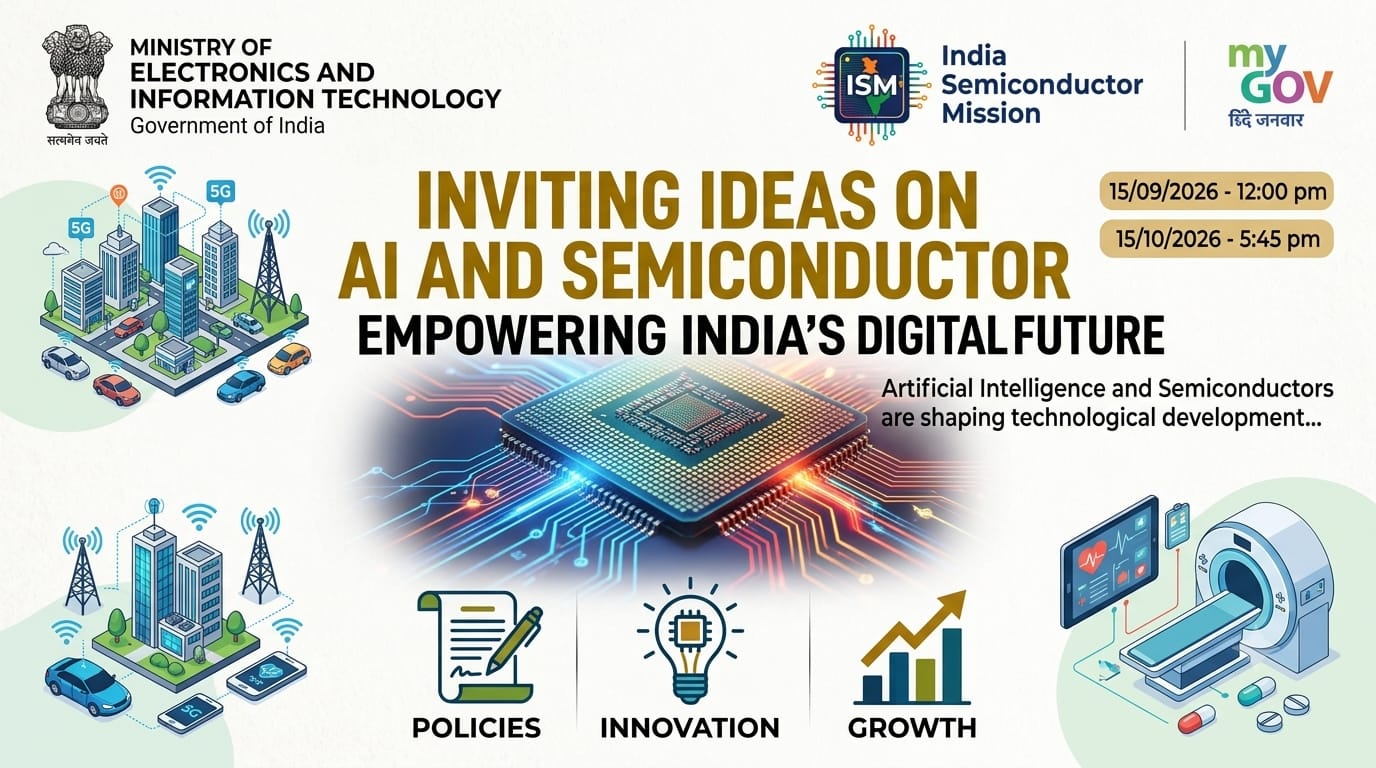
Artificial Intelligence and Semiconductors are shaping the technological development landscape. As AI applications continue to expand, new possibilities are emerging across areas such as chip design, computing, manufacturing and advanced technologies.
Share your ideas and perspectives on the evolving landscape of AI and Semiconductors.
What new possibilities, ideas and innovations can emerge at the intersection of these technologies?
What new possibilities can emerge from AI and Semiconductor technologies?

1 day 23 hours ago
This submission tackles a critical and often overlooked dimension of AI in chip design: trust. While much attention focuses on accelerating design with AI, this work asks how we ensure AI-generated RTL is safe, correct, and resistant to manipulation. The proposed verification-first workflow, combining threat mapping, automated gates, guardrails, and an open benchmark, offers a practical path to harness AI's speed without sacrificing reliability. The emphasis on building secure habits from the start, especially for emerging ecosystems like India's, makes this both timely and actionable.
(0.11 MB)

2 days ago
We are developing an energy-aware AI computing platform inspired by biological learning: it processes information efficiently, adapts over time, and retains useful knowledge without repeatedly retraining large models. Our software prototype has been validated through end-to-end simulations of continual learning, memory/replay, adaptive decision-making, energy tracking, and robustness under noise and hardware-like constraints.
We have also created an early simulation model of non-volatile memory behavior to explore how future low-power hardware could support the architecture. The next step is hardware enablement: partner with semiconductor and device teams to obtain measured memory-device data, calibrate our models, implement the core engine in digital CMOS, and evaluate selected non-volatile-memory blocks through a test-chip program. The goal is more affordable, power-efficient, private AI for edge applications such as healthcare, industry, robotics, and secure devices.

2 days 4 hours ago
Ray Industries provides:-
the advanced manufacturing manufacturing tech,
GenAl optimizations, and supply chain logic
that allow Hangyard top scale flawlessly.
(0.11 MB)

2 days 5 hours ago
Focus on Healthcare, Smart Cities & Green Tech
Key Possibilities from AI & Semiconductor Synergies:
Next-Gen Medical Devices: Ultra-low-power AI chips enabling wearable diagnostic tools, continuous glucose/ECG monitoring, and portable ultrasound scanners for rural healthcare.
Smart City & Traffic Management: Edge-AI sensors embedded in urban infrastructure for real-time traffic flow optimization, reduced emissions, and smart energy grid balancing.
Green Computing & Energy Efficiency: Novel chip designs (like Neuromorphic and GaN semiconductors) combined with AI optimization to drastically reduce data center power consumption.
Precision Agriculture: Custom IoT chips for real-time soil health tracking, automated drone spraying, and crop disease prediction.
Indigenization of High-Tech Manufacturing: Driving domestic R&D and manufacturing of specialized silicon to boost economic growth and self-reliance under ISM.

2 days 10 hours ago
The development of artificial intelligence technology should be permitted in a manner that aligns with India's interests. At the same time, India should also support the new regulations being formulated by nations worldwide to control the growth of AI

2 days 10 hours ago
AI and semiconductors are no longer separate sectors; together they form the infrastructure of national power. The contest is over compute, chips, memory, energy, data, talent, manufacturing and standards. Dependence on foreign processors can become strategic vulnerability.
India must pursue resilience, not isolation. Integrate AI–semiconductor policy with defence, energy, telecom, manufacturing and education. Map dependencies, secure trusted supply chains, strengthen chip design and advanced packaging, expand sovereign compute and build efficient AI infrastructure.
Security must not suppress innovation. Accelerate high-value, low-risk AI; subject high-risk autonomous systems to testing, accountability and human control.
The objective is clear: India must not merely consume AI. It must design, compute, manufacture, secure and govern it. In the AI–semiconductor era, technological dependence is strategic dependence.
(0.09 MB)

2 days 11 hours ago
These technologies could potentially make AI faster and more energy efficient
AI + semiconductors for healthcare
Specialised chips could enable AI-powered medical devices that operate locally.
Democratizing AI
One of the most interesting possibilities is making AI available on inexpensive devices.
If semiconductor innovation dramatically reduces the cost and power requirements of AI processing, advanced AI could become accessible to:
Small businesses
Schools
Rural communities
Entrepreneurs
For example:
Wearable sensor → Semiconductor processor → AI analysis → Early warning
This could support continuous monitoring without constantly transferring sensitive health data to the cloud.
AI + semiconductors for agriculture
Affordable AI-enabled semiconductor sensors could analyse:
Soil conditions
Crop health
Water requirements
Pest activity
Weather conditions
This could make precision agriculture accessible to smaller farmers rather than only large agricultural companies.

2 days 13 hours ago
India could establish AI and Semiconductor Innovation Hubs connecting universities, semiconductor companies, startups, research institutions and students. These hubs could provide shared access to chip-design software, AI accelerators, semiconductor fabrication partnerships, testing facilities and expert mentorship. Students could design small AI processors, develop edge-AI applications and experiment with hardware-software co-design rather than learning these technologies only theoretically. Innovation challenges could focus on Indian priorities such as agriculture, healthcare, language technology, clean energy and smart manufacturing. Such an ecosystem would help create a strong talent pipeline and encourage indigenous intellectual property, startups and research collaborations at the intersection of AI and semiconductor technologies.
2 days 13 hours ago
A major future opportunity lies in developing neuromorphic semiconductor architectures inspired by the human brain. Unlike conventional processors that frequently move data between memory and computing units, neuromorphic chips can process information through networks of artificial neurons and synapses, potentially reducing energy consumption for specific AI workloads. These systems could be particularly valuable for robotics, autonomous vehicles, wearable devices and real-time sensors that need to respond immediately to their surroundings. Research could focus on combining emerging semiconductor materials, memory technologies and event-driven AI algorithms. Developing such brain-inspired hardware could create a new generation of intelligent machines that operate efficiently with limited power and computational resources.
2 days 13 hours ago
AI can make semiconductor manufacturing more efficient by creating intelligent semiconductor factories. Machine-learning systems can continuously analyze equipment performance, temperature, vibration, chemical processes and microscopic inspection data to detect abnormalities before they cause production failures. AI could predict equipment maintenance requirements, optimize manufacturing parameters and identify defects at extremely early stages. Digital twins of fabrication facilities could allow engineers to simulate production changes before implementing them on the factory floor. Combining AI with advanced sensors and semiconductor manufacturing could improve yield, reduce material wastage and lower production costs. This could strengthen semiconductor supply chains and support the development of resilient domestic manufacturing ecosystems.
Please
Log In
to submit a comment.