Home | MyGov

Accessibility
Accessibility Tools
Color Adjustment
Text Size
Navigation Adjustment
Screen Reader iconScreen Reader

Inviting Global Ideas & Suggestions For LiFE - Building an Environmentally Sustainable Future

Inviting Global Ideas & Suggestions For LiFE - Building an Environmentally Sustainable Future
Start Date :
Jun 15, 2022
Last Date :
Jul 31, 2022
23:45 PM IST (GMT +5.30 Hrs)
Submission Closed

India is one of the leaders in sustainable development and clean energy. With the Hon PM Narendra Modi-led government’s reform-oriented, environment-friendly policies, the ...

India is one of the leaders in sustainable development and clean energy. With the Hon PM Narendra Modi-led government’s reform-oriented, environment-friendly policies, the country has time & again shown that sound environmental policies can pave the way to a sound economy.

At the UN Climate Change Conference COP26 in 2021, PM Shri Narendra Modi announced the ‘LiFE’, a mission to bring individual behavioural change at the forefront of the global climate action narrative. LIFE or Lifestyle for Environment along with the ‘Pro Planet People’ movement, aims to strengthen the efforts to overcome climate change.

LiFE will replace the prevailing 'use-and-throw’ thinking with an environmentally conscious lifestyle. The Mission is to create a global community of ‘Pro-Planet People’ (P3), who with their shared commitment will adopt and promote environmentally friendly lifestyles.

Individual Efforts Are Key to Climate Commitment

India's traditional knowledge strongly positions it to lead the narrative of addressing climate change. Like many other mass movements, LiFE aims to inspire climate action based on the mantra of ‘Sabka Sath, Sabka Vikas’.

MyGov invites you to share your ideas and suggestions on how to adapt to an environmentally conscious lifestyle.

1. Reduce
2. Reuse
3. Recycle
4. Renewable
5. Recover
6. Re-design
7. Re-manufacture

Few examples for the above:
Reduce - Electricity, Fuel Usage
Reuse - Old Clothes, Electronics, Building materials, furniture
Recycle - Plastic, newspapers, cartons, boxes
Renewable - Solar, Wind, Hydro, Tidal, Geothermal & Biomass
Recover - Forests, rivers, soil, mountains, wildlife
Redesign - Green buildings
Remanufacture - E-waste for new purposes

Our civilisational values have taught us the importance of living in harmony with nature. Today, let’s come together to protect our environment & take forward Mission LiFE - Lifestyle for Environment.

Reset
Showing 2859 Submission(s)
GARAIYA AKSHAY
GARAIYA AKSHAY 3 years 5 months ago
Sustaining agriculture has the potential to help diversify farmers' sources of food and income, make farming climate-resilient, optimise use of natural resources and re-build ecosystems. It also offers a vital alternative to input-intensive farming, he said.
Harisharan Sahoo
Harisharan Sahoo 3 years 5 months ago
All is well...Our govt. gives us so many opportunities in all the depts...so many thanks to our honourable PM SHRI NARENDRA MODI JI...
GARAIYA AKSHAY
GARAIYA AKSHAY 3 years 5 months ago
To maintain effective control of pests, it is a core factor to view the farm as an ecosystem instead of a factory. For example, many animals and birds are natural predators of agricultural pests. Therefore, manage your farm so that it can harbour populations of these insect predators. However, chemical insecticides can lead to the indiscriminate killing of insect predators.
GARAIYA AKSHAY
GARAIYA AKSHAY 3 years 5 months ago
Agroforestry has become a strong tool for farmers in arid regions with soils prone to desertification. Also, it engaged in the growth of trees and shrubs among crops or grazing land and agriculture. And it is forestry practices for long-lasting, productive and diverse land uses when approached sustainably.
SrideviV
SrideviV 3 years 5 months ago
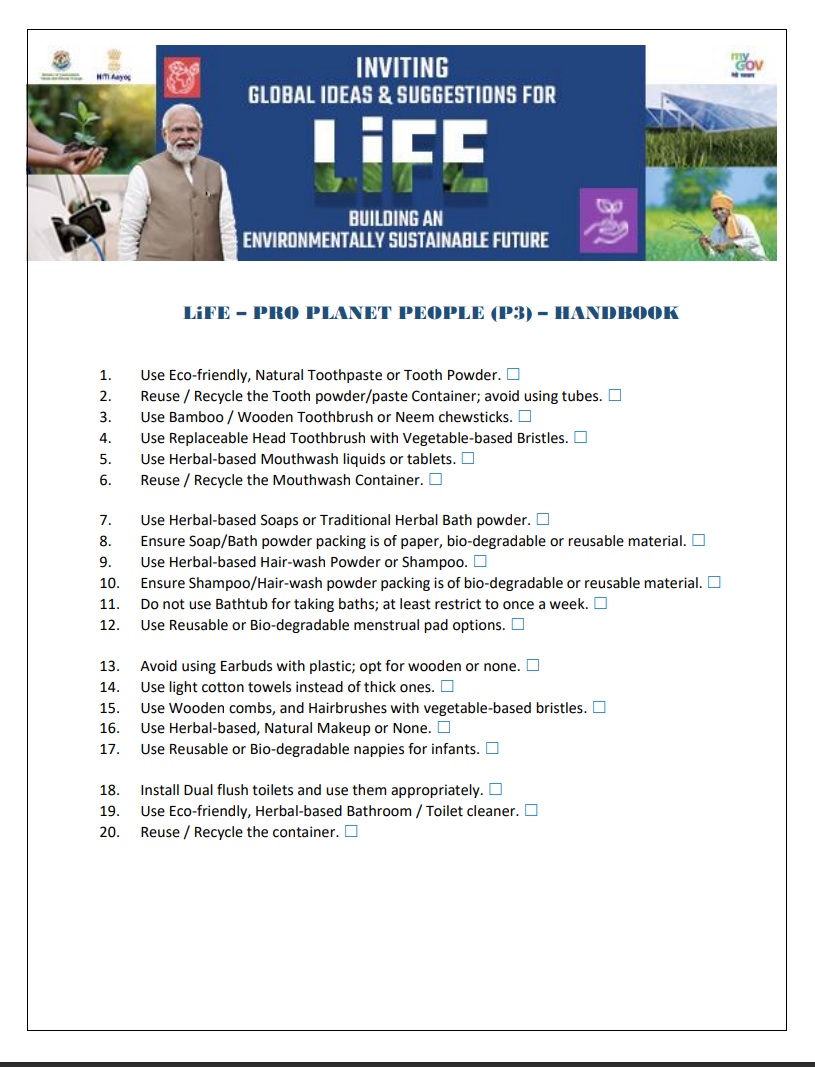
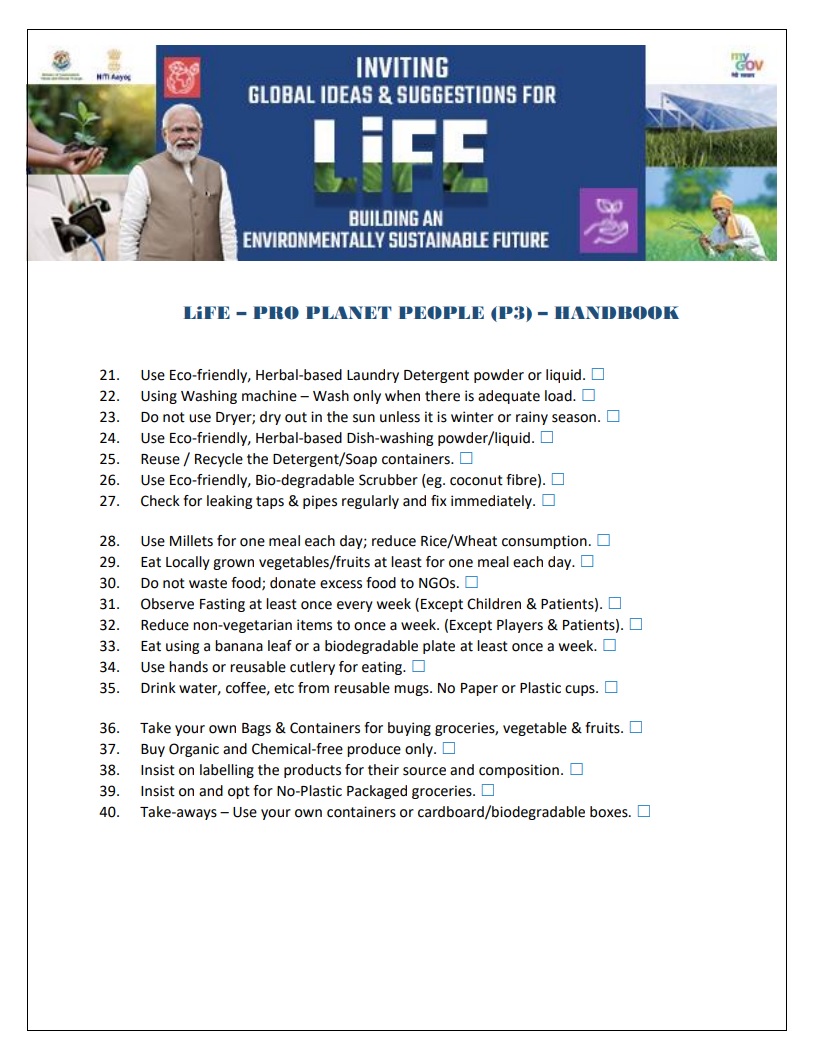
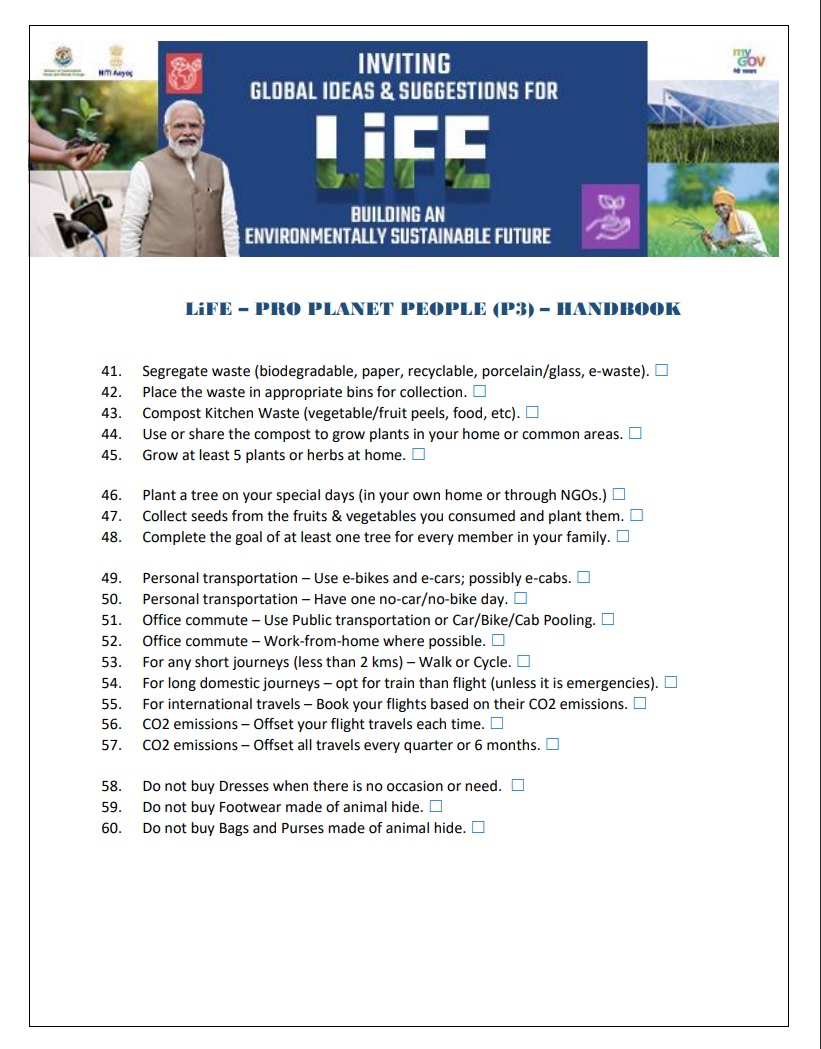
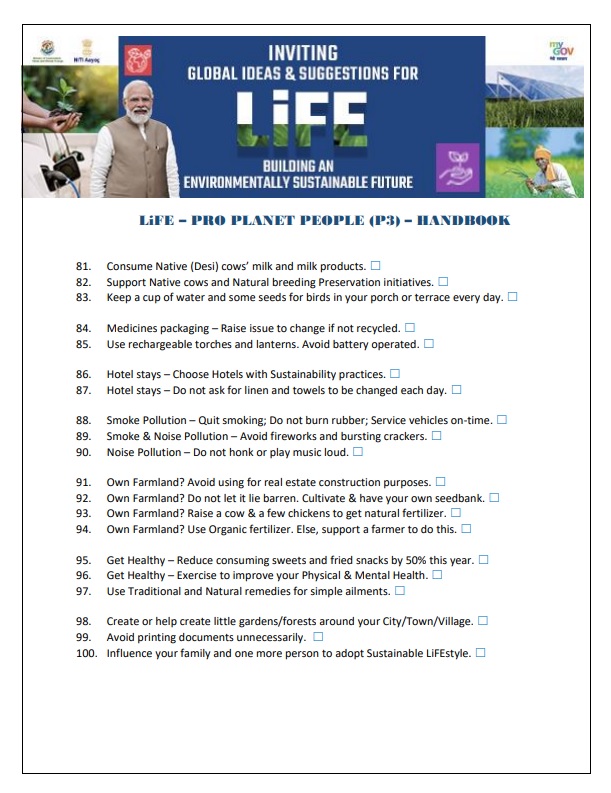
"LiFE & Pro Planet People - Handbook" Hello, It is heartening to see individuals being asked to submit our suggestions for the 'LiFE' mission. My family started our environment conscious lifestyle a few years ago; the changes vary from 'Small & Easy' to 'Large & Impactful'. Based on our experience/knowledge, I have compiled a Checklist of 100 changes that individuals can make to their LiFEstyle & reduce the carbon footprint. Changes include, - Personal Hygiene options - Cleaning/Washing options - Food habits - Travel/Commute changes - Shopping habits - Energy Usage - Conservation activities My Handbook (Jivana-Shastra / Vade mecum) images are attached for your kind perusal. Can our government publish an Official Handbook with changes we need to make along with respective emission reductions? I also suggest awarding "Green Badges/ Tax Credits" on making 25/50/75/100 changes. Thank you, Sridevi MAY OUR LITTLE DROPS HELP MAKE THE MIGHTY OCEAN
mygov_1659287219108029631
mygov_1659287225108029631
mygov_1659287232108029631
mygov_1659287239108029631
mygov_1659287245108029631
GARAIYA AKSHAY
GARAIYA AKSHAY 3 years 5 months ago
The foremost step in water management is the choosing of the right crops and also local crops are selected which are suited to the weather conditions of the area. In addition, crops that do not require a lot of water should be selected for dry areas.
GARAIYA AKSHAY
GARAIYA AKSHAY 3 years 5 months ago
Biodynamic farming incorporates holistic and ecological growing practices based on the “anthropology” philosophy. In addition, it focuses on implementing practices like composting application of animal manure, supplementary crops or rotating cover crops. Also, these practices generate the soil fertility necessary for food production.
GARAIYA AKSHAY
GARAIYA AKSHAY 3 years 5 months ago
Biodynamic farming incorporates holistic and ecological growing practices based on the “anthropology” philosophy. In addition, it focuses on implementing practices like composting application of animal manure, supplementary crops or rotating cover crops. Also, these practices generate the soil fertility necessary for food production.
GARAIYA AKSHAY
GARAIYA AKSHAY 3 years 5 months ago
Polyculture farming technique is similar to crop rotation which tries to follow natural principles to get the best yield. Therefore, it engages in growing multiple crop species in one region. Also, these species generally complement each other and help bring out a greater variety of products on the same plot while fully utilising the available resources. The high biodiversity makes the polyculture sustainable farming system more flexible to seasonal fluctuations..