Home | MyGov

Accessibility
Accessibility Tools
Color Adjustment
Text Size
Navigation Adjustment
Screen Reader iconScreen Reader

Discussion on Consultation Paper on City GDP Measurement Framework

Start Date :
Feb 25, 2019
Last Date :
Apr 01, 2019
00:00 AM IST (GMT +5.30 Hrs)
Submission Closed

“Dull, inert cities, it is true, do contain the seeds of their own destruction and little else. But lively, diverse, intense cities contain the seeds of their own regeneration, ...

“Dull, inert cities, it is true, do contain the seeds of their own destruction and little else. But lively, diverse, intense cities contain the seeds of their own regeneration, with energy enough to carry over for problems and needs outside themselves.” – Jane Jacobs

By most accounts, Indian cities exemplify Jacobs’s description of ‘lively’, ‘diverse’, and ‘intense’. There is a greater socio-cultural diversities in our cities with strong forces of assimilation and integration. Collectively, people in Indian cities contribute a far higher share in the country’s GDP than what their share in the national population. More than one study has confirmed the existence of ‘agglomeration economies’. This means that firms and people show higher productivity in cities. By 2050, India is likely to add 416 million population to the world’s urban population vis-à-vis 255 million for China. India’s rural population is likely to come down by a few million during the same period. All of these underline the status of Indian cities as the true ‘engine of growth’. Yet, Indian cities miss one thing that most other engines have – ‘a check engine light’.

In other words, there are very few tractable indicators of the economic activity in a city. The Central Statistics Office (CSO) releases all India GDP data disaggregated by rural and urban areas for selected years. There are a few other estimates available from private agencies and researchers but these are again either aggregate urban estimates, or one-off exercises. The lack of this critical data point has led the Ministry of Housing and Urban Affairs (MoHUA) to appoint a team under Technical Assistance for Smart Cities (TASC) to conduct the following activities:

•Explore the availability of suitable data at the national, state and city level which can be used to
estimate city level GDP;
•Develop a framework to estimate city level GDP based on available data sets; and
•Estimate city GDP and adjust it suitably to reflect spatial productivity differences.

Several stakeholders are expected to benefit from these estimates including policymakers and planners, private sector and citizens and researchers. Policymakers will be able to use this data to plan for future infrastructure investments and raise finances for the same. The private sector will be able to use this data to complement public investment, strategize business decisions. They will also be empowered to identify ‘emerging city economies’ – i.e. future investment destinations, beyond the usual metropolitan suspects. Citizens may use this data to make migration decisions, and academicians and researchers will be able to exploit the data to undertake critical research in urban economics and planning. It would also foster a spirit of competition amongst the cities. Our cities are on a path of prosperity except that the economic progress remains unmeasured. We have made a benign attempt to generate annual city GDP statistics with the release of this framework document while recognizing the fact that it may be challenging.

This consultation paper presents the draft framework developed by the TASC, for city GDP estimation. We would like to invite your feedback/ suggestions/ recommendations on the proposed framework, using the feedback link provided on http://smartnet.niua.org/city-gdp or on MyGov by 31st March, 2019. We look forward to your participation in this journey.

Click here to read Consultation Paper on City GDP Measurement Framework

Reset
Showing 527 Submission(s)
Bhawesh Kumar Singh
Bhawesh Kumar Singh 6 years 9 months ago
I think it will need some serious hard work in the beginning, but it can be practical. Also, it will also assist "smart" development in both government and private sectors. Therefore, I support this framework.
Ujjwal Rai
Ujjwal Rai 6 years 9 months ago
Modi ji ke aane ke baad India ki GDP me aviswashniya badlaw aaya h hamne kabhi aisa socha bhi nahi tha ki India ki GDP itni teji se badhega iska sara shrey Adarniya Shri Narendra Modi Ji ko jaata h mai puri Bharat ke taraf se Narendra Modi ji ko Naman karta hu
Mitul Kansal
Mitul Kansal 6 years 9 months ago
India’s GDP is forecast to expand 7.5% in FY20 and 7.7% in FY21. China’s growth is seen at 6.2% in both years. “India’s economy is poised to pick up in 2019, benefiting from lower oil prices and a slower pace of monetary tightening than previously expected, as inflation pressures ease
Mitul Kansal
Mitul Kansal 6 years 9 months ago
The per capita income of India, measured as per capita net national income at current prices, registered a growth of 30.2 per cent from financial year 2014-2015 to 2017-2018. The per capita income of India jumped to Rs 1,12,835 in FY18 from Rs 86,647 in FY15, ANI said in a report citing Central Statistics Office (CSO) estimates.
Mitul Kansal
Mitul Kansal 6 years 9 months ago
From 1960 to 2013, Indian economy’s average share in the world was at 1.8 per cent.Interestingly, Indian economy recorded an average growth rate of 7.3 per cent between financial year 2014-2015 to 2017-2018, the fastest growth rate amid major economies in the world.
Mitul Kansal
Mitul Kansal 6 years 9 months ago
India is ranked 6th largest economy with $2.848 trillion Nominal GDP with an estimate of 7.4% Growth in 2018–2019. Where as China holds second spot with $14.092 trillion Nominal GDP with an estimate of 6.6% Growth in 2018–2019.
Mitul Kansal
Mitul Kansal 6 years 9 months ago
The Indian economy advanced 6.6 percent year-on-year in the last three months of 2018, below a downwardly revised 7 percent expansion in the previous period and market expectations of 6.9 percent. It is the lowest growth rate in five quarters as weak consumer demand and government spending held back expansion. GDP Annual Growth Rate in India averaged 6.21 percent from 1951 until 2018, reaching an all time high of 11.40 percent in the first quarter of 2010 .
Rishav namdeo
Rishav namdeo 6 years 9 months ago
आदरणीय प्रधानमंत्री जी नमस्कार, सबसे बड़ी समस्या वर्तमान समय मे हर जगह नेतागिरी हावी है अधिकारी काम कर नही सकते क्योंकि फोन आ जाते है यह हाल किसी एक जगह का नही पूरे देश का है और किसी एक पार्टी का नही सभी का यही हाल है निवेदन है इसमें कार्यबाही करे एबम योजनाओं का जमीनी लाभ जनता को मिल सके इस पर बहुत बड़े निर्णय लेने होंगे जातिबाद से उठकर काम करना होगा वेरोजगारी समस्या है और बो बनी रहेगी चाहे शासन कोई भी हो निवेदन है कुछ कठिन निर्णय लिए जाए और देश को जातिबाद से मुक्त किया जाए
Biswajit Adhikary
Biswajit Adhikary 6 years 9 months ago
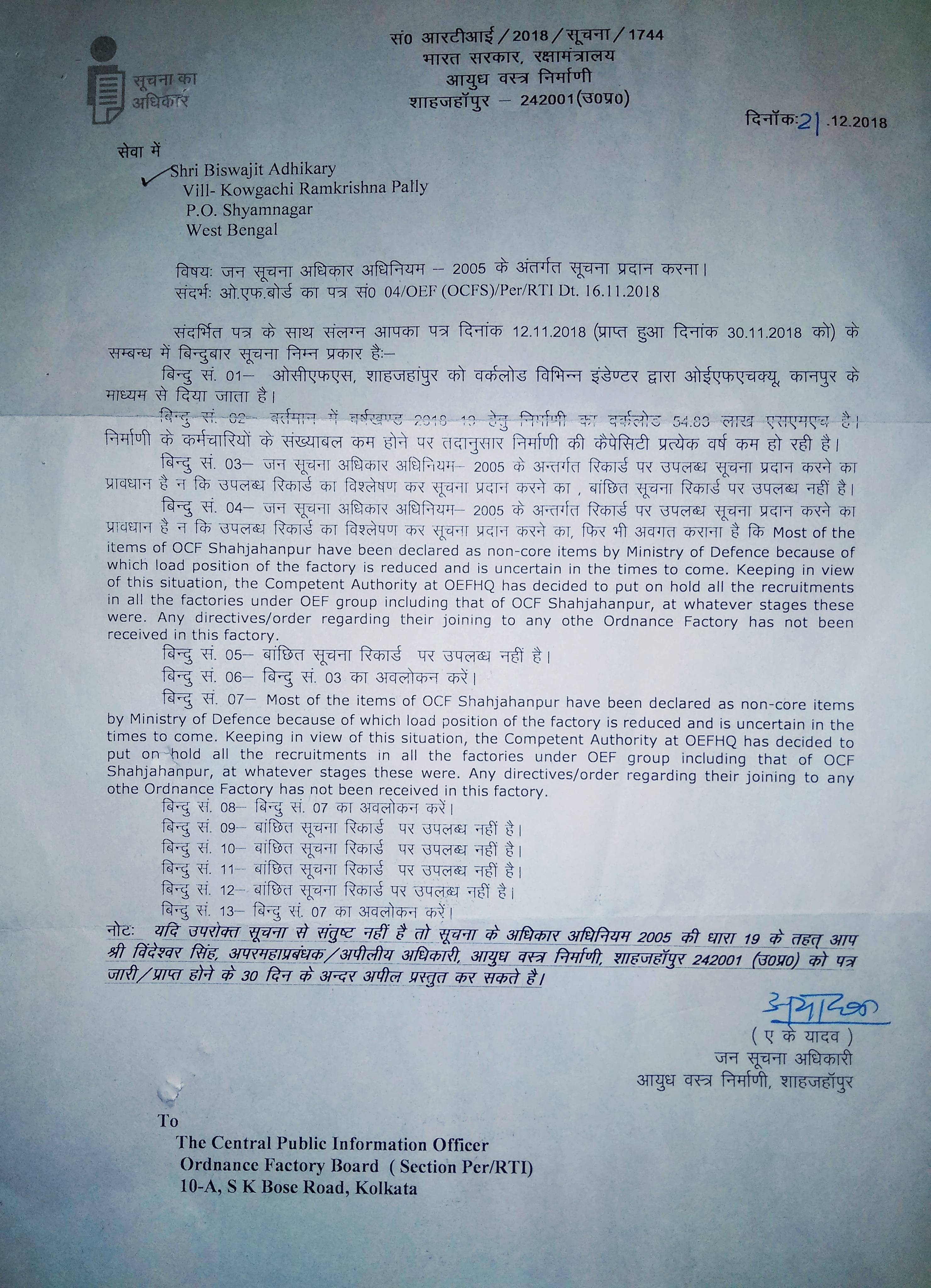
OCF SHAHJAHANPUR ORDNANCE FACTORY k GM ko joining k lea order da. Ministry of defence k karan 104 Tailor selected candidate ki joining roke dea gaya ha. Prime minister k office kiu is k upor koi action kiu nahi lea ja raha ha. Youva aj barojger ha,or naukry mil na ki bad v ap k non core policy k karan joining ruka hua ha. Kaya apko pata ha.
mygov_1552552934799905