
Home | MyGov

Accessibility
Accessibility Tools
Color Adjustment
Text Size
Navigation Adjustment
Screen Reader iconScreen Reader

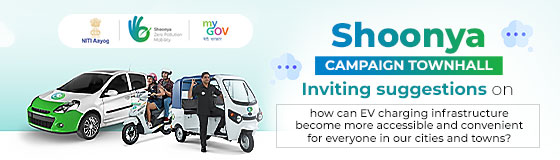
Shoonya Campaign Townhall - Inviting Suggestions on how can EV charging infrastructure become more accessible and convenient for everyone in our cities and towns

Shoonya Campaign Townhall - Inviting Suggestions on how can EV charging infrastructure become more accessible and convenient for everyone in our cities and towns
Start Date :
Jan 16, 2024
Last Date :
Feb 16, 2024
23:45 PM IST (GMT +5.30 Hrs)
Submission Closed

The NITI Aayog-led Shoonya campaign, in partnership with MyGov India, is thrilled to announce the electric vehicles Townhall, an open discussion platform for citizens to share ...

The NITI Aayog-led Shoonya campaign, in partnership with MyGov India, is thrilled to announce the electric vehicles Townhall, an open discussion platform for citizens to share valuable ideas and suggestions to promote and enhance the clean electric mobility ecosystem in India. The Townhall focuses on electric vehicles (EVs) and their associated advantages, including cost savings, clean air, health benefits, and emission reduction.

In line with this initiative, NITI Aayog in collaboration with MyGov, invites input from citizens.

To learn more about the Shoonya Campaign and discover the benefits of EVs, please visit the Shoonya campaign website at www.shoonya.info

Reset
Showing 435 Submission(s)
MANOJ KUMAR DWIVEDI
MANOJ KUMAR DWIVEDI 1 year 11 months ago
There are two main types of EV chargers: Alternating current (AC) charging stations and direct current (DC) charging stations. Electric vehicle batteries can only be charged by direct current electricity, while most mains electricity is delivered from the power grid as alternating current. Electric vehicles have very low maintenance costs because they don't have as many moving parts as an internal combustion vehicle. The servicing requirements for electric vehicles are lesser than the conventional petrol or diesel vehicles. Therefore, the yearly cost of running an electric vehicle is significantly low. “The reason why they are expensive is because the EV drivetrain includes a battery which forms about 40-45% of the cost. High demand for battery materials has been pushing up costs which led to a big spike in the battery cost in 2022. It went up to as high as $155/kWh.”
MANOJ KUMAR DWIVEDI
MANOJ KUMAR DWIVEDI 1 year 11 months ago
These obstacles range from high upfront investment for fast charging stations, lack of standardisation in charging guns (inter-operability), grid capacity & stability, non-uniform electricity supply codes across states & UTs, significant processing time & capital for new electrical connections, land acquisition & ... Like the battery in your phone or laptop, your EV battery can degrade over time. This means that it's unable to cope with the high charge rate, which results in slower charging times. While this is fine if you're leaving your vehicle overnight, it can cause problems when you want a rapid roadside top-up. Direct current fast charging (DCFC) equipment offers rapid charging along heavy-traffic corridors at installed stations. DCFC equipment can charge a BEV to 80 percent in just 20 minutes to 1 hour. Most PHEVs currently on the market do not work with fast chargers.
MANOJ KUMAR DWIVEDI
MANOJ KUMAR DWIVEDI 1 year 11 months ago
How many public charging stations are currently available in India? 5,254 public charging stations are currently operational in India. To meet its 2030 goals, India needs a total of 46,397 stations. Until then, India can complement the existing fast charging infrastructure with slow chargers to meet EV drivers' needs. EV charging infrastructure refers to the network of charging stations and related equipment that allows electric vehicle owners to charge their vehicles' batteries. A robust and technologically advanced EV charging infrastructure will support EV adoption, mitigate range anxiety, and reduce greenhouse gas emissions. To meet the demand for charging stations, India requires ideally 1 charger for every 40 EVs, thus it demands for over 4 lakh charging stations annually. Cumulative charging stations annually are expected to be 1.32 million by 2030.
MANOJ KUMAR DWIVEDI
MANOJ KUMAR DWIVEDI 1 year 11 months ago
Increased Access to Transportation Options: Enhancing India's EV charging stations mitigates range anxiety, promoting wider EV adoption. Comprehensive infrastructure catalyzes e-mobility sector growth, progressing toward a sustainable transportation ecosystem. DC fast chargers, also commonly known as Level 3 chargers, typically provide charging through a 480 V input and will require a special socket in your electric vehicle (CCS/CHAdeMO). Depending on your vehicle, these fast-charging stations can provide an 80% charge in less than an hour by converting AC power to DC power.
MANOJ KUMAR DWIVEDI
MANOJ KUMAR DWIVEDI 1 year 11 months ago
Collaborations between public and private entities are key to scaling up EV charging infrastructure. Local governments can work with private companies to develop charging networks, ensuring both accessibility and reliability. A comfortable waiting space ensures that users can remain at the station while their EVs charge without discomfort. Incorporating accessibility features such as lighting, disabled access, clear signage, and thoughtful infrastructure design is essential when building EV charging stations. Enhancing India's EV charging stations mitigates range anxiety, promoting wider EV adoption. Comprehensive infrastructure catalyzes e-mobility sector growth, progressing toward a sustainable transportation ecosystem. For day-to-day, home charging is the best option. It's usually much cheaper and more convenient than other charging options - if you're lucky enough to have off-street parking and can get a home charger installed of course.
Sanjay Kumar Pandey
Sanjay Kumar Pandey 1 year 11 months ago
Improving electric vehicle (EV) charging infrastructure accessibility and convenience is crucial for the widespread adoption of electric vehicles and the transition to more sustainable transportation systems. Achieving this goal requires a multi-faceted approach addressing various aspects of infrastructure development, technological advancements, and user experience enhancements. **1. **Expanding Charging Networks:** One key strategy is to expand the coverage of charging stations, making them readily available in urban and suburban areas. This involves collaboration between governments, businesses, and energy providers to invest in the deployment of a dense network of charging points. Targeting high-traffic areas such as shopping centers, public parking lots, and residential neighborhoods ensures accessibility for a diverse range of users. **2. **Universal Charging Standards:** Establishing universal charging standards is essential to enhance convenience for EV users. A standardized
PawanKumarNagda
PawanKumarNagda 1 year 11 months ago
"Shoonya Campaign's latest townhall invites innovative ideas to revolutionize EV charging infrastructure, making it more accessible and convenient in urban and rural areas. I think the government should help to install EC Charging stations at all current petrol Pumps. Today people hesitate in buying electric vehicles due to lack of charging stations. If charging facility is also available at the existing petrol pumps then it will become very easy and the country will move towards EV at a rapid pace. Pawan Kumar Nagda Udaipur, Rajasthan
Ritik Sanatani
Ritik Sanatani 1 year 11 months ago
"Shoonya Campaign's latest townhall invites innovative ideas to revolutionize EV charging infrastructure, making it more accessible and convenient in urban and rural areas. This initiative aims to tackle key challenges in EV adoption, such as limited charging stations and long charging times. Your suggestions can help shape a greener, more efficient future for transportation. Join the movement to drive change and make electric vehicles a viable option for everyone. Let's collaborate for a sustainable, electric-powered tomorrow!" Thanks