Home | MyGov

Accessibility
Accessibility Tools
Color Adjustment
Text Size
Navigation Adjustment
Screen Reader iconScreen Reader

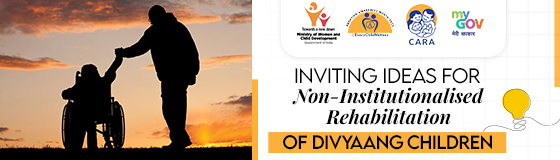
Inviting Ideas for Non-Institutionalised Rehabilitation of Divyaang Children

Inviting Ideas for Non-Institutionalised Rehabilitation of Divyaang Children
Start Date :
Oct 01, 2025
Last Date :
Nov 30, 2025
17:30 PM IST (GMT +5.30 Hrs)
Submission Closed

In 2025, the Central Adoption Resource Authority (CARA) is placing special focus on promoting family-based care for children with special needs (Divyaang children). In ...

In 2025, the Central Adoption Resource Authority (CARA) is placing special focus on promoting family-based care for children with special needs (Divyaang children). In collaboration with MyGov, CARA invites all Indian citizens to participate in an important national discussion on the theme:
“Non-institutionalized Rehabilitation of Children with Special Needs (Divyaang Children)”

This initiative seeks to create a collaborative platform where citizens can:
1. Share insights on the challenges and barriers in the identification and adoption of children with special needs
2. Suggest innovative ideas, strategies, or solutions to strengthen the adoption ecosystem
3. Contribute to policy-making by offering actionable recommendations to ensure a loving family environment for every child, especially those currently residing in Specialized Adoption Agencies (SAAs) and Child Care Institutions (CCIs)

Your thoughtful suggestions can play a key role in shaping a more inclusive, compassionate, and efficient adoption framework for Divyaang children.

Who can participate?
All Indian citizens are welcome to join the conversation and submit their ideas.

Why participate?
Selected entries may be featured in national-level publications, exhibitions, and even considered in policy discussions aimed at improving the lives of children with special needs.

Let’s work together to ensure every child finds a loving family and a brighter future. Join the discussion today and be a voice for change!

Reset
Showing 777 Submission(s)
user_366270
user_366270 5 months 1 week ago
for functional independence and mobility, effectively bringing the benefits of advanced rehabilitation to the community level. ​On the policy front, a critical step is the de-institutionalization fund reallocation. Governments must commit to systematically diverting resources and funding streams away from large, isolated residential facilities and redirecting them to bolster community-based support systems, inclusive schools, and family financial aid. This policy shift ensures that early intervention services are universally available from birth, as timely intervention drastically reduces the need for extensive institutional support later on. Policy must also mandate disability-inclusive development across all sectors, making local governance, public health services, and common infrastructure fully accessible. Finally, establishing a robust national tracking and monitoring system—with community oversight—is necessary to ensure quality control, prevent abuse.
user_366270
user_366270 5 months 1 week ago
Technology, Policy, and Global Best Practices for Inclusion ​The non-institutional model is significantly strengthened by leveraging technology and adopting forward-thinking national policies aligned with global standards like the UN Convention on the Rights of Persons with Disabilities (UNCRPD). Technology is a powerful equalizer, making specialized services accessible even in the most remote areas. Tele-rehabilitation platforms and mobile apps can connect children and caregivers directly with professional therapists (physiotherapists, speech pathologists, and psychologists) for live sessions and guided home programs, overcoming geographic isolation and transportation barriers. These digital tools can also provide personalized learning modules and adaptive content, allowing the child to progress at their own pace. Furthermore, the development of low-cost assistive technology (AT)—such as customized 3D-printed orthotics or locally-sourced communication devices—is essential
user_366270
user_366270 5 months 1 week ago
holistic outcome measurement, and rights-based activism ensures the long-term viability of community inclusion and transitions the care model from charity to a fundamental right.
user_366270
user_366270 5 months 1 week ago
Sustaining Community-Based Rehabilitation ​Effective non-institutional care requires sustainable funding models and rigorous measurement. Funding must pivot from solely supporting large institutions to decentralized budget allocation for local services, therapy materials, and caregiver stipends. This can be achieved through Public-Private Partnerships (PPPs), leveraging Corporate Social Responsibility (CSR) funds to adopt specific community rehabilitation centers or mobile units. Measuring success must move beyond medical outcomes; it focuses on functional inclusion metrics, such as the school enrollment rate of Divyang children in mainstream schools, their participation in local social groups, and the economic independence of the primary caregiver. Crucially, the process must be underpinned by strong advocacy, fostering self-advocacy among the children themselves as they grow, and empowering family networks to demand their rights. This combination of targeted financial investment.
user_366270
user_366270 5 months 1 week ago
These groups become local sources of mutual support, shared knowledge, and collective advocacy, giving them a unified voice to demand better local services and greater inclusion. ​By integrating these strategies, the community itself becomes the most powerful and sustained rehabilitation center, ensuring that the Divyang child grows up with dignity, identity, and full participation alongside their peers, free from the isolation and limitations of institutional living.
user_366270
user_366270 5 months 1 week ago
Community Cyber Ambassadors: Establishing a network of community volunteers who are trained in digital literacy and accessibility. They can help Divyang children access online learning, connect with distant specialists via telehealth, and engage with inclusive digital platforms. ​Sensitization Campaigns: Launching sustained, local awareness campaigns that use popular culture—like street plays (nukkad natak), local radio, and parent success stories—to challenge stigma and normalize disability. The focus must be on celebrating the abilities and contributions of individuals, shifting public perception from pity to respect. ​Accessible Public Infrastructure: Advocacy must focus on making public spaces, including local schools, libraries, playgrounds, and transport, physically and socially accessible. This is the community's responsibility to accommodate the individual, not vice versa. ​Self-Help Groups (SHGs) and Advocacy: Encouraging the formation of SHGs for both Divyang children.
user_366270
user_366270 5 months 1 week ago
and specialist teachers (physical, speech, and special educators) can travel on a fixed schedule, bringing expertise to the community's doorstep. ​Peer Buddy Systems: Training mainstream students as "peer buddies" or tutors provides social support, encourages genuine inclusion, and helps break down societal prejudice. This system benefits both the Divyang child (social confidence) and the peer (empathy and understanding). ​Community Vocational Workshops: Partnering with local artisans, cooperatives, and small businesses to offer accessible, prevocational training (e.g., digital art, data entry, candle making, tailoring, weaving). The goal is to build skills that lead directly to micro-enterprise or local employment, fostering economic independence within the community. ​III. 🤝 Social Inclusion and Community Empowerment ​True rehabilitation means maximizing the child's participation and sense of belonging in their society, a principle central to the Social Model of Disability.
user_366270
user_366270 5 months 1 week ago
income. ​Crisis Prevention and Respite Care: To prevent burnout and potential family abandonment, community-based respite centers are vital. These centers can offer temporary, planned, or emergency day-care for the child, allowing caregivers time for personal needs, work, or rest, thereby making long-term home care feasible. ​II. 📚 Inclusive Education and Skill Development ​Rehabilitation is incomplete without equal access to education and livelihood opportunities. The focus shifts from special schools to fully inclusive mainstream education. ​Universal Design for Learning (UDL): Mainstream schools must adopt the UDL framework, using differentiated instruction and multiple modes of content delivery (visuals, tactile materials, auditory aids) so that one curriculum can meet the needs of all students. ​Mobile Resource Units ("Therapy Vans"): In rural and remote areas, a physical center isn't always feasible. Mobile vans equipped with therapeutic tools, simplified learning modules.
user_366270
user_366270 5 months 1 week ago
Caregiver Training and Psycho-Social Support: This is the foundational pillar. Trained community health workers (CBR workers) must provide regular home visits to teach parents and family members how to administer daily physiotherapy, speech therapy, and occupational therapy exercises. This shifts the role of the parent from a passive recipient to an active therapeutic partner, fostering a deeper bond and continuity of care. ​Financial and Material Assistance: Economic hardship is a major driver of institutionalization. Governments and NGOs must provide: ​Direct Financial Subsidies (like a child disability allowance) to offset the costs of specialized nutrition, care, and assistive devices. ​Free or Subsidized Assistive Devices (wheelchairs, hearing aids, spectacles) delivered directly to the home or community center, bypassing bureaucratic hurdles. ​Specialized Health Coverage (e.g., an extended health card) that covers rehabilitation-related medical costs regardless of family