

Home | MyGov

Accessibility
Accessibility Tools
Color Adjustment
Text Size
Navigation Adjustment
Screen Reader iconScreen Reader

Inviting comments and suggestions on the Draft Accessibility Standards for the Services Sector

Inviting comments and suggestions on the Draft Accessibility Standards for the Services Sector
Start Date :
Oct 10, 2025
Last Date :
Oct 31, 2025
17:30 PM IST (GMT +5.30 Hrs)
Submission Closed

The Department of Empowerment of Persons with Disabilities (DEPwD), Ministry of Social Justice & Empowerment (MSJE), in collaboration with MyGov, invites comments and suggestions ...

The Department of Empowerment of Persons with Disabilities (DEPwD), Ministry of Social Justice & Empowerment (MSJE), in collaboration with MyGov, invites comments and suggestions from stakeholders and the general public on the draft accessibility standards for the Services Sector. These draft standards, which identify non-negotiable rules, have been prepared to strengthen the creation of barrier-free environments in accordance with the Rights of Persons with Disabilities Act, 2016 and relevant rules.

The draft document is now available for review. Click here to read.

All interested individuals are requested to carefully examine the proposed standards and submit their feedback, comments, and suggestions on the MyGov platform, ensuring that personal details are entered accurately during registration.

Reset
Showing 376 Submission(s)
MANIKANDAN E elumalai
MANIKANDAN E elumalai 1 month 1 week ago
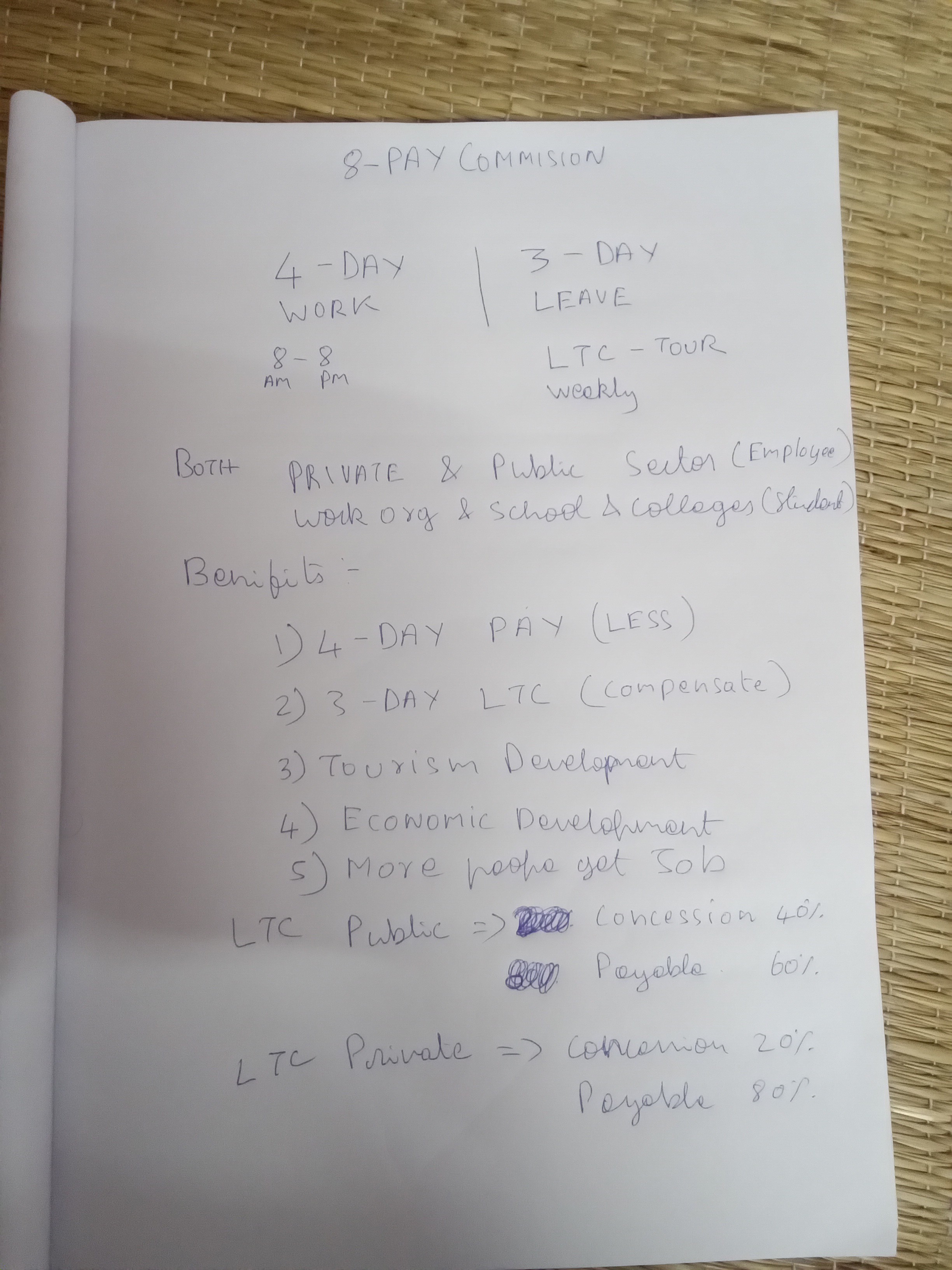
Respected modi ji 8 pay commission 4 day work a week, 3 day leave with LTC 4DAY A WEEK 1)LESS PAY SO MORE NUMBERS OF GOVT OR PRIVATE JOB INCREASES 2) EMPLOYEES RELIEF 3DAY LTC TOURISM DEVELOPMENT ECONOMIC GROWTH WORK LIFE BALANCED 8 AM TO 8 PM =12 HOUR WORK HALF HOUR LUNCH QUATER HOUR 2 BREAK GOOD FOR BOTH ECONOMIC AND EMPLOYEES TO GOVERNMENT ALSO PER DAY 2000 = 4×4= 32000/ MONTH + LTC BENFITS
mygov_176183227965764571
Khushrajpatel
Khushrajpatel 1 month 1 week ago
Respected sir/ madam, my name is khushrajpatel. Iam from Telangana ZPHSQUTHBULLAPUR Government school. service sector is very important to our society or country. It's helping to growing fastly and it's making economic and It's a backbone of modern economics.
user_366270
user_366270 1 month 1 week ago
The draft standards, while commendable, must be strengthened by ensuring true, measurable accountability and broad inclusion beyond physical access. We suggest mandating third-party accessibility audits—conducted by certified organizations that include Persons with Disabilities (PwDs) on their teams—to be carried out every two years and requiring a public, centralized portal for PwDs to easily report non-compliance across all service providers. To address comprehensive inclusion, the standards must explicitly detail requirements for cognitive and neurodiverse accessibility (e.g., simplified language for financial documents, providing designated quiet zones in busy service areas like airports or hospitals). Finally, for effective and equitable compliance, the rules should clearly outline financial incentives (like tax deductions or subsidies) for small and medium enterprises (SMEs) to offset the initial cost of retrofitting and mandate a uniform, comprehensive disability etiquette.
user_366270
user_366270 1 month 1 week ago
as non-compliance can attract significant penalties starting at ₹10,000 for the first offense and escalating to ₹5,00,000 for repeated violations, emphasizing the non-negotiable nature of these new rules.
user_366270
user_366270 1 month 1 week ago
The Draft Accessibility Standards for the Services Sector, initiated by the DEPwD under the mandate of the RPwD Act, 2016, is a crucial legal framework intended to make all public and private services uniformly accessible for the 21 specified categories of disabilities. The draft applies across a wide spectrum of services, notably including banking and financial services (ATMs, counter services), aviation and transport (airports, ticketing), healthcare, education, and digital/OTT platforms. Key provisions focus on mandating not just physical changes, but also inclusive operational policies: this involves setting technical standards for digital accessibility (e.g., adherence to WCAG for all online platforms and apps), requiring multi-sensory communication (e.g., tactile markers and audio announcements in public spaces), and demanding mandatory, certified training for staff on disability etiquette and handling assistance equipment. Furthermore, the standards are backed by legal weight.
user_366270
user_366270 1 month 1 week ago
to interact with customers with diverse disabilities. The central government is currently inviting all stakeholders—including individuals, organizations of persons with disabilities, and industry bodies—to submit their feedback and suggestions, usually through platforms like MyGov.in, to refine these rules before they are finalized, ultimately making the provision of services universally inclusive and compliant with the law.
user_366270
user_366270 1 month 1 week ago
The core information regarding the topic, "Inviting comments on draft accessibility standards for service sector," is detailed in the paragraph below, focusing on the purpose, scope, and key enforcement mechanisms of the proposed rules. ​The Department of Empowerment of Persons with Disabilities (DEPwD) has initiated a public consultation by releasing draft accessibility standards for the massive service sector, including critical areas like finance, transportation, healthcare, and digital media (e.g., OTT platforms). This action is mandated under the Rights of Persons with Disabilities (RPwD) Act, 2016, with the overarching goal of establishing mandatory, non-negotiable rules to ensure a barrier-free environment in India. The standards are designed to encompass various needs, covering physical infrastructure requirements (like ramps and accessible pathways), communication services (such as Braille, audio descriptions, and synchronized closed captions), and the proper training of staff
user_366270
user_366270 1 month 1 week ago
​The Invitation (What you can do): The government is actively inviting comments and suggestions from stakeholders, experts, organizations, and the general public. This is a critical step in the rule-making process to ensure the final standards are practical, comprehensive, and effectively address the real-world needs of persons with disabilities.