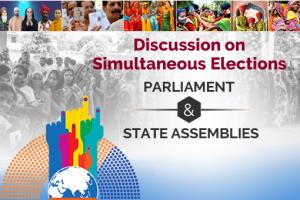
The desirability of holding simultaneous elections for the Lok Sabha and Vidhan Sabhas has been discussed at various levels. A considered view is that simultaneous elections will ...
The desirability of holding simultaneous elections for the Lok Sabha and Vidhan Sabhas has been discussed at various levels. A considered view is that simultaneous elections will not only keep alive the enthusiasm of voters, but will also result in huge savings to the public exchequer as well as avoiding repetition of administrative effort. It is also expected to control the expenses of political parties. Simultaneous elections will also avoid repeated enforcement of the Model Code of Conduct which affects administrative actions by the government.
President of India, His Excellency Shri Pranab Mukherjee has also expressed his views on the desirability of holding simultaneous elections. Speaking at a recent function, The President said that “With some election or the other throughout the year, normal activities of the government come to a standstill because of code of conduct. This is an idea the political leadership should think of. If political parties collectively think, we can change it.... The Election Commission can also put in their idea and efforts on holding the polls together and that will be highly beneficial”
Hon'ble Prime Minister Shri Narendra Modi has spoken several times on considering the feasibility of holding simultaneous Lok Sabha and state assembly elections. In two recent TV discussions, the Prime Minister reiterated this idea and invited a national debate on the issue.
Debate on the Issue - A Brief History
In India, simultaneous elections to the Lok Sabha (House of The People) and Vidhan Sabhas (State Legislative Assemblies) were organized in the years 1951-52, 1957, 1962 and 1967. Thereafter, however, the schedule could not be maintained and the elections to the Lok Sabha and the Vidhan Sabhas have still not been realigned.
The next General Election to the Lok Sabha is scheduled for 2019. Elections for the Vidhan Sabhas of 5 States are scheduled for 2017, for 13 States in 2018, for 9 States in 2019, for 1 State 2020 and the remaining are scheduled for 2021.
The issue of simultaneous elections was debated by the Law Commission in its 107thReport in 1999 (Reform of Electoral Laws) , where in it was mentioned that – “The rule ought to be one election once in five years for Lok Sabha and all Legislative Assemblies” ( Para 7.2.1.1 of the Report). Recently, Parliamentary Standing Committee on Personnel, Public Grievances, Law and Justice presented its 79th Report on ‘Feasibility of holding Simultaneous Elections to the House of People (Lok Sabha) and State Legislative Assemblies’ on 17th December 2015.
Several structural changes will need to be done in case a decision is made to conduct simultaneous election, including possibility of Constitutional amendments to Articles 83, 172, 85 and 174 to streamline the process.
Seventy Ninth Report Parliamentary Standing Committee for PERSONNEL, PUBLIC GRIEVANCES, LAW AND JUSTICEMyGov Discussion
MyGov invites citizens, Parliamentarians, Members of Legislative assemblies and councils, constitutional experts, academics experts, bureaucrats, social media influencers, Think Tanks and all other interested people to give their considered view on the subject. The issues that can be considered while formulating a view are (only an indicative list and not exhaustive):
1. Is it desirable to hold simultaneous elections? What are the pros and cons?
2. If simultaneous elections are held, then for the first time what happens to assemblies whose scheduled tenure either ends before or after the proposed date of holding elections?
3. Should the term of Lok Sabha and assemblies be fixed?
4. What would happen in case by-elections are necessitated in between terms?
5. What happens in case the ruling party or coalition loses majority in between term, either in Lok Sabha or in State assemblies?
You may submit your opinion by either writing in the comment box below, or by attaching a PDF document, or through a Youtube video.
The last for submitting your opinion is 15th October, 2016.
#SimultaneousElections.-One India One Election is a great step so that it can prohibit communalism, casteism, corruption and crony capitalism. But we need to check it's feasibility as well to conduct simultaneous elections as current process only takes long time and so much of manual work beacuse of that teachers of many schools only are asked for help.
There should be enough 'dedicated'(No school teachers) manpower to handle this. Otherwise this is great initiative.
1) Simultaneous elections could take away the time dynamics nature of both the houses of parliament which makes bicameral system effective in the federal system like ours
2) Abridges the rights of citizens to indirectly doing mid course correction in the case of existing electoral system
In view of above reasons, strictly making simultaneous elections on the grounds of administrative convenience is against the spirit of Indian Polity envisioned in the Indian Constitution.
Yes it is a welcoming idea by our hon'ble PM and hon'ble president of India.it is time-saving and citizens of our country will easily cast their votes at a time.
Hon. PM has given concept of simultanious election is good, but, According to the general experience, election is very good source of income of poor and needy people or at the time of election,poor and needy people can get employment and income, further, it is also important sources of black money to brought out and to be distributed and circulated in economy by making expenses, the benifit of it also get to poor and needy people, hence, it should be considered for determining policy,best wishes
मैं आपकी इस नीति से सहमत हूँ।
इससे कई फायदे है जैसे की एक साथ चुनाव कराने से समय बचेगा, धन भी बचेगा, और उस समय का सदुपयोग हो सकेगा ।
धन और समय बचने से देश का विकास होगा, देश तरक्की करेगा, और विकसित भारत बनेगा
I am agree in my country all election is do one time and after 5year is no election and second type pry minster or president is elected directly people , there only 2perty in yes are no or independent elected person select it time in one any bhartiya eligible person .