Home | MyGov

Accessibility
Accessibility Tools
Color Adjustment
Text Size
Navigation Adjustment
Screen Reader iconScreen Reader

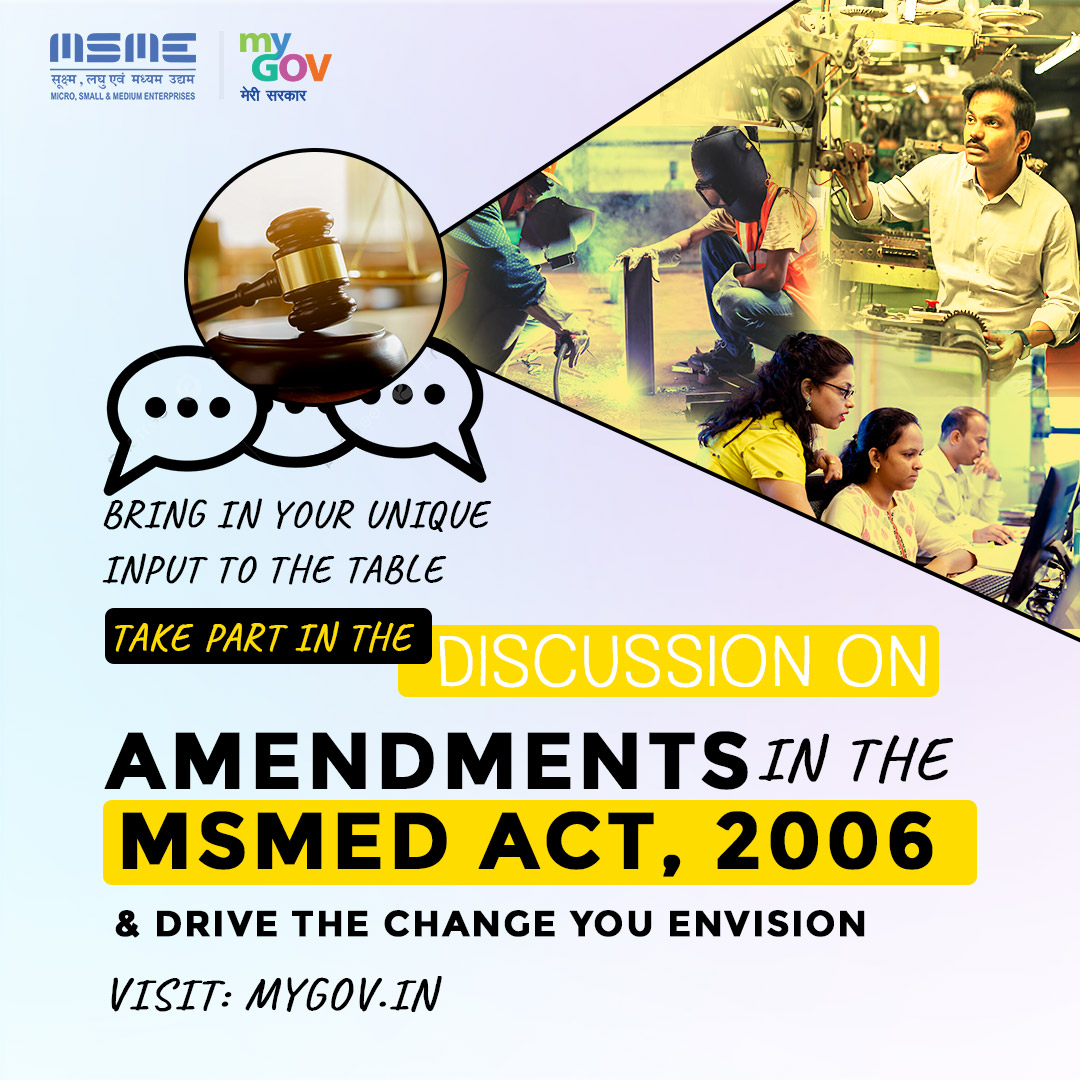
Discussion on Amendments in the MSMED Act 2006

Discussion on Amendments in the MSMED Act 2006
Start Date :
Jul 05, 2024
Last Date :
Aug 05, 2024
23:45 PM IST (GMT +5.30 Hrs)
Submission Closed

The Ministry of MSME is in the process of amending the MSMED Act, 2006. In this regard, this Ministry had consulted various central Ministries/Department/State Govt./Industry ...

The Ministry of MSME is in the process of amending the MSMED Act, 2006. In this regard, this Ministry had consulted various central Ministries/Department/State Govt./Industry Associations/other stakeholders & general public.

Based on the consultations and written inputs received from various stakeholders, the amendments proposed in the MSMED Act, 2006 are based on the following four key pillars:

A) Enhancing inclusivity and broad-basing the scope of the Act;
B) Future-proofing the Act;
C) Improving co-ordination under the Act;
D) Enhancing the ease of business in the ecosystem;

A) Enhancing Inclusivity and Broad-basing the scope of the Act
• Accord statutory status to Udyam registration for availing benefits under the Act.
• Provision for credit guarantee coverage to Micro and Small Enterprises by Government.
• Enabling provisions to address issues of credit gap; shortage of working capital; ensure adequate, affordable, and timely finance to enterprises; minimize the incidence of financial stress among enterprises; and leverage new and emerging platforms and technologies such as the Trade Receivables Discounting System, Account Aggregator Framework, etc.
• Provision for targeted mechanisms for capacity building of women, members of SC and ST, and rural artisans and craftspeople and provisions for market access, financial and digital literacy.
• Inclusion of cottage, village, and coir industries as rural artisans and craftspeople in the MSME classification scheme, to promote rural industries and enterprises.
• Inclusion of Medium Enterprises in the dispute resolution framework

B) Future-proofing the Act
• Strengthen provisions for technological upgradation and green technology to enhance productivity, quality, and competitiveness.
• Enabling provisions for the adoption of energy-efficient, sustainable technologies by MSME.
• Designation of a Green Fund to support the energy transition of MSME and integration in the global value chain.
• Addressing industrial obsolescence among enterprises.
• Promoting technological upgradation and research and development among enterprises.
• Encouraging the adoption of sustainable technology solutions by enterprises.

C) Improving coordination
• Streamline the structure, working, and functions of the National Board and the Advisory Committee to make them lean, efficient, and responsive to the requirements of MSME, and strengthen the monitoring and evaluation mechanism.
• Provision to set up an adequate number of Facilitation Councils in States for better access to MSMEs, along with an incentive structure to promote competition and good performance among them.
• The composition of the Facilitation Councils may be prescribed by the State Government.

D) Enhancing Ease of Business in the Ecosystem
• Provisions for the decriminalisation of offences by converting criminal fines into civil penalties.
• Simplification of regulatory clearance mechanism and procedure for establishment and management of MSME by making suitable provisions in the Rulemaking powers of the appropriate Government.
• Creating and encouraging the adoption of digital solutions to improve transparency and foster a culture of accountability
• Make the adjudication process simpler and speedier, aligning it with the alternative dispute resolution framework and online dispute redressal.

Please Click Here to Read more.

Reset
Showing 768 Submission(s)
RITAM MISRA
RITAM MISRA 1 year 8 months ago
in msme industries many trained iti qualified people work and has nice experience, so either ask western nations and aboroad countries to recognise indian iti or to setup their exam centres here and govt help in reskilling courses so that they can pass exam, gain more knowledge and use it to either get job in abroad or contribute more in indian economies, many iti semi skilled men are poor and can not afford usa or canada or europe skill trade exam course and can not afford flite ticket to go and give exams there
PARASARAMLAXMANJADHAV
PARASARAMLAXMANJADHAV 1 year 8 months ago
Dear Sir, Govt has to simplicity in GST for Small scale Industries. Its very Tough to comply the regulation of GST for small scale industries because of Limited knowledge and resources. We are receiving many NOTICES of from GST after 3-4 years . demanding interest and penalty.. so many small business are closing due to financial crisis and unable to fulfill the demands of GST.. Govt has to promote the Small scale Industry... our Humble request to the act in GST with simplicity... and Wave off Interests and penalty at least if any compliances are not Met in previous period.. also if any thing has gone wrong in filing GST.. Dept. has to bring to notice within specified period within next quarter. Insted of This GST dept issues notice after 4-5 years with Interest and penalty. Please Stop harassing the small scale Industries.
Sanjay Kumar Pandey
Sanjay Kumar Pandey 1 year 8 months ago
The Micro, Small, and Medium Enterprises Development (MSMED) Act of 2006 in India has been pivotal in providing a legal framework for the recognition and promotion of these enterprises. Over the years, several amendments have been made to enhance its effectiveness and address emerging challenges. This discussion will delve into the key amendments made to the MSMED Act 2006 and their implications. ### Background and Objectives of the MSMED Act 2006. The MSMED Act 2006 was enacted to promote, develop, and enhance the competitiveness of micro, small, and medium enterprises (MSMEs). It aimed to facilitate their growth by providing various support measures including credit, technology, infrastructure, and marketing assistance. The Act also mandated the classification of MSMEs based on their investment in plant and machinery or equipment for manufacturing or service activities. This is my idea . Written by SANJAY KUMAR PANDEY Address - Vill Turi kala post - Zindapur 824234 mob ,8340406993
BikkinaVenkateswararao
BikkinaVenkateswararao 1 year 8 months ago
People also ask What is the MSME Act 2006 Amendment 2023? The Finance Act 2023 introduced Section 43B(h), allowing deductions for timely payments to Micro and Small enterprises under the MSMED Act. It promotes working capital availability and prompt payments. Applicable from April 1, 2024, it requires payment within specified time limits. Not more than Rs.50 crore and Annual Turnover ; not more than Rs. 250 crore. New definition of MSME, View Notification. Website Content Owned and Managed by Ministry of Micro, Small & Medium Enterprises, Government of India Designed, Developed and Hosted by National Informatics Centre( NIC ) Last Updated: 01 Feb 2023. MSME New Definition under the MSMED Act Types of Enterprises Revised MSME Limits Micro Enterprises Net investment in plant and machinery or equipment up to Rs.1 crore and net turnover ≤ Rs.5 crores Small Enterprises Net investment in plant and machinery or equipment ≤ Rs.10 crores and net turnover ≤ Rs.50 crores Registered MSMEs
kunal kishore
kunal kishore 1 year 8 months ago
MSMED ACT is a regulator of msme sector.there are some modification regarding it.first point is to clear cut and easy definition of msme sector.second this act has broad concept for implement all over country.third area wise policy to protect their traditional art and craft of particular area.fourth a MSME portal has been launched to registered all small and medium scale industry.