Government of IndiaGOVERNMENT OF INDIA
Skip to main content
English language
Accessibility
Accessibility Tools
Color Adjustment
Text Size
Navigation Adjustment
Screen Reader iconScreen Reader
MyGov Twitter
MyGov Facebook
MyGov Youtube
MyGov Instagram
MyGov Linkedin
MyGov Whatsapp
Meri Sarkar Logo

Recent Searches

      Close

      Get Involved

      • Groups
      • Do/Tasks
      • Discuss
      • Poll/Survey
      • Blog
      • Talk
      • Quiz
      • MG Prime
      • Campaigns
      • Pledge
      • Podcast
      • Media
      • Periodicals

      MyGov States

      • Andaman & Nicobar Islands
      • Arunachal Pradesh
      • Assam
      • Chandigarh
      • Chhattisgarh
      • Dadra and Nagar Haveli and Daman and Diu
      • Goa
      • Gujarat
      • Haryana
      • Himachal Pradesh
      • Jammu And Kashmir
      • Jharkhand
      • Karnataka
      • Ladakh
      • Madhya Pradesh
      • Maharashtra
      • Manipur
      • Mizoram
      • Nagaland
      • Rajasthan
      • Tamil Nadu
      • Tripura
      • Uttar Pradesh
      • Uttarakhand
      • Lakshadweep
      • Odisha
      • Puducherry
      • Sikkim

      Microsites

      • Blog
      • Campus
      • Innovate India
      • Pledge
      • Quiz
      • Saathi
      • Self4Society
      • Transforming India
      • PM Events

      Get to Know

      • MyGov: An Overview
      • Associate with MyGov
      • Work at MyGov
      • Circulars
      • Pulse Newsletter
      • Tenders
      • Weekly Newsletter
      • Meity Dashboard
      • Sectors
      • Skills
      • Area of Interest
      • Age Group
      • National Events
      • Archive Sites

      Help/Feedback

      • Contact Us
      • FAQ
      • Feedback
      • Help
      • Link To Us
      • Public Grievance
      • Site Map
      • Terms & Conditions
      • Usage of Aadhaar
      • Web Information Manager
      • ICC
      • MyGov Social
      • Points and Badges
      • Website Policies
      user-profile
      Together, Let's Engage In Good Governance 
      Login/Register
      1. Home
      2. Discuss
      3. Inviting Ideas for Next Phase of Rural Sanitation
      Facebook X
      Inviting Ideas for Next Phase of Rural Sanitation
      Start Date 01/08/2026 - 11:49
      End Date 02/10/2026 - 23:45
      Time zone: IST (GMT +5.30 Hrs)
      Login to Participate
      Sector:
      Water & Sanitation
      Created : 1/08/2026
      620
      Total Comments
      453
      Users Participated

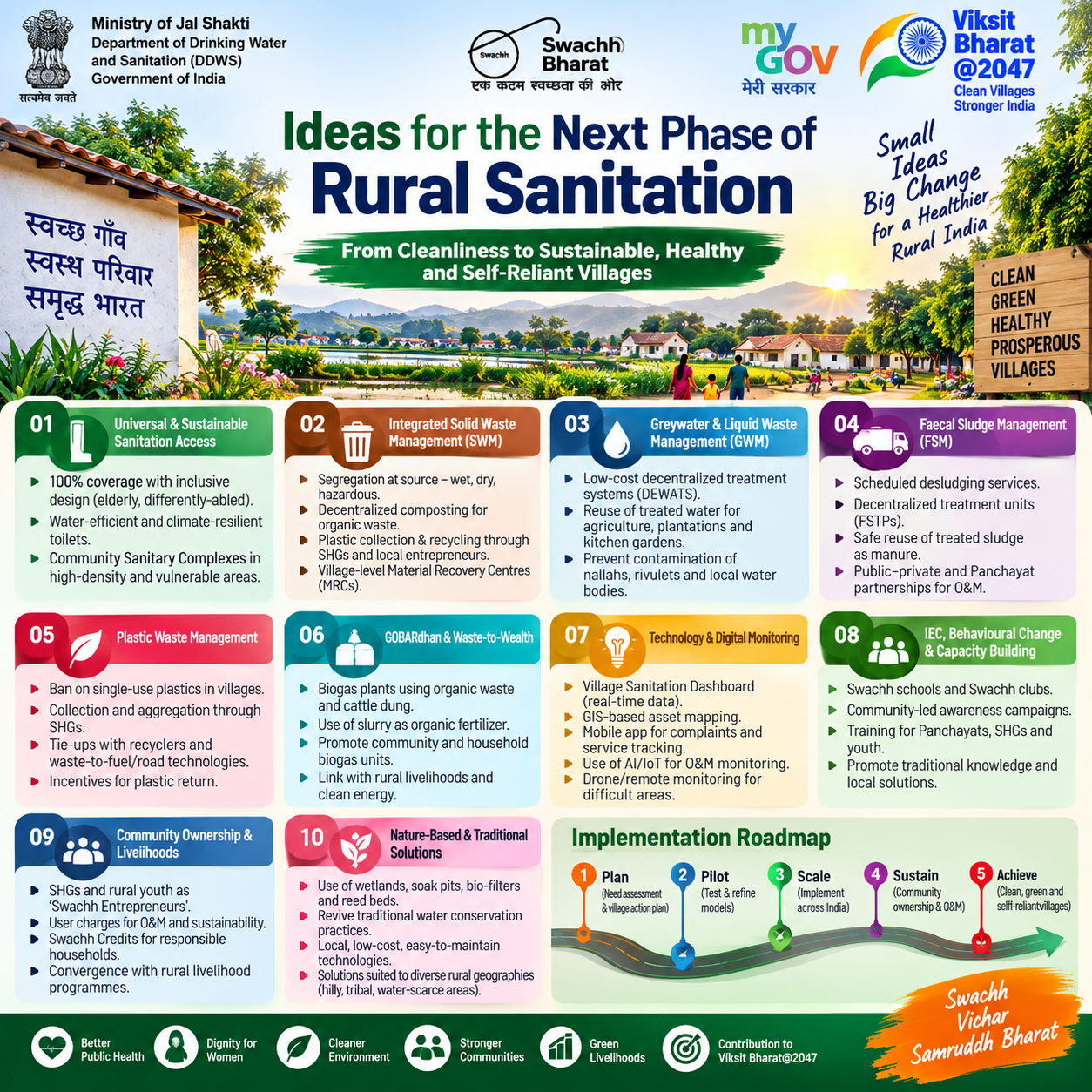
      In the last 12 years, SBM(G) has evolved from a sanitation programme into a nationwide movement that has improved public health, enhanced dignity of women, empowered communities and promoted sustainable rural development. Building on the achievement of Open Defecation Free (ODF) status, SBM(G) 2.0 has expanded its focus to sustaining sanitation outcomes through interventions such as Individual Household Latrines (IHHLs), Community Sanitary Complexes (CSCs), Solid and Liquid Waste Management, Plastic Waste Management, Faecal Sludge Management, GOBARdhan, Information, Education and Communication (IEC) and Capacity Building. The current phase of the Mission is scheduled to conclude in March 2027.

      As the Department prepares the roadmap for the next phase of rural sanitation, it seeks ideas from citizens to sustain and strengthen the gains achieved under SBM(G) while addressing emerging challenges related to waste management, resource recovery, environmental sustainability, Operation & Maintenance (O&M) and long-term community ownership of assets and outcomes. Innovative, practical and scalable solutions are required to enhance sanitation service delivery, strengthen waste management systems, promote behavioural change and accelerate the transition towards a circular waste-to-wealth economy. Given that the diversities of rural areas from urban cities, suggestions and ideas, specific to rural scenarios will be highly appreciated. Along with these, with peri-urban areas / villages also growing fast and having characteristics of urban centers, solutions specific for such areas are also being sought.

      The success of SBM(G) has been driven by the spirit of Jan Bhagidari (People's Participation). Citizens, Gram Panchayats, SHGs, youth, Swachhagrahis and other stakeholders have been at the forefront of transforming rural sanitation and their continued participation will remain critical for sustaining these achievements. 

      Accordingly, the Department of Drinking Water and Sanitation (DDWS), Ministry of Jal Shakti in collaboration with MyGov, invites citizens, youth, Gram Panchayats, SHGs, academic and research institutions, development partners and other stakeholders to share their suggestions and ideas for the next phase of rural sanitation programme on the following:

      1. Areas to be taken up (including existing areas where gaps may be remaining)
      2. New technological interventions for SWM, GWM, FSM.
      3. Rural Sanitation 
      4. Solutions for treating pollution in small nallahs/rivulets discharging into rivers in rural areas.
      5. Adoption of solutions based on traditional knowledge and ancient wisdom in new settings for rural India. 
      6. Any other area related to the programme.

      The suggestions received will help and guide the next phase of SBM(G) and contribute to building cleaner, healthier and environmentally sustainable villages that will be strong contributors for achieving the goal of Viksit Bharat@2047.

      Participation Guidelines 

      1. All Citizens, youth (including students), Gram Panchayats & SHGs, academic and research institutions, development partners, NGOs and other stakeholders are invited to contribute ideas for shaping the next phase of rural sanitation and solid-liquid waste management under Swachh Bharat Mission (Grameen).
      2. For detailed information about SBM(G) Phase II, applicants may visit the SBM(G) Phase II operational guidelines available on website of the Department (https://swachhbharatmission.ddws.gov.in). The guidelines can also be assessed through: https://swachhbharatmission.ddws.gov.in/sites/default/files/Guidelines/SBMG%20Phase-II%20Operational%20Guidelines.pdf 
      3. Suggestions may be submitted on any of the major components of SBM(G), including Individual Household Latrines (IHHLs), Community Sanitary Complexes (CSCs), Solid Waste Management, Liquid Waste Management, Plastic Waste Management, GOBARdhan, Faecal Sludge Management, Information, Education and Communication (IEC) and Capacity Building. Global best practices forming the bases of solution, may also duly mentioned and referred.
      4. Participants are encouraged to propose innovative, technology-driven, scientific, managerial, practical, feasible and scalable solutions to address rural sanitation challenges and strengthen long-term sustainability.
      5. Suggestions should focus on supporting the Department of Drinking Water and Sanitation (DDWS), Ministry of Jal Shakti, in developing the roadmap for the next phase of rural sanitation for India.
      6. Participants are required to register on the MyGov platform and submit their suggestions through the prescribed online form.
      rajeshmahato@yahoo.com
      RAJESH MAHATO
      2 weeks ago

      Lack of access to household toilets. Continued practice of open defecation. Poor maintenance of sanitation facilities. Inadequate fecal sludge and waste management. Shortage of water for sanitation purposes. Low awareness of hygiene and health practices. Financial constraints for construction and upkeep. Limited technical support and skilled manpower. Poor sanitation facilities in schools and public places. Safety and privacy concerns, especially for women and girls. Lack of inclusive facilities for elderly and differently-abled persons. Weak monitoring and evaluation mechanisms. Seasonal challenges such as floods and droughts affecting facilities. Difficulty in changing long-standing social and cultural behaviors. Ensuring long-term sustainability and regular usage of toilets. Focus Areas for New Ideas Water-saving sanitation solutions Affordable and durable toilets Smart monitoring systems Community behavior change initiatives

      Like 1
      Dislike 0
      • Reply
      Facebook X
      Akshay Jain_16
      Akshay Jain
      2 weeks 1 day ago

      अगर हम ऐसे इको एटीएम शुरू कर सकें जिनमें पुराने या खराब फोन िमा जकए िा सकें और बदले में ग्राहक नकद या यूपीआई के माध्यम से ऑनलाइन भुगतान प्राप्त कर सकें, तो यह भारत में एक क्ाांजतकारी कदम होगा। अगर हम ग्रामीण बैंकोां और भारतीय स्टेट बैंक की शाखाओां में ऐसे इको एटीएम स्थाजपत कर दें जिनमें पुराने या खराब फोन िमा जकए िा सकें, तो मोबाइल सुरजित रहेंगे और डेटा चोरी से सुरजित रहेगा। अगर ग्राहक को फोन का मूल्य जमल सके, तो हम कैजशफाई और बैंकोां की मदद से इस इको एटीएम पररयोिना को शुरू कर सकते हैं। यह एक शानदार पररयोिना होगी और हम पुराने फोन उनकी कांपजनयोां के अनुसार बेच सकेंगे और अगर कांपनी बांद हो गई है, तब भी हम मोबाइल फोन स्वीकार कर सकते हैं।

      Like 1
      Dislike 0
      • Reply
      Facebook X
      dvis505@gmail.com
      Deepak Kumar Vishwakarma
      2 weeks 1 day ago

      Respected Sir Sabhi Villages Mai Har Ghar Water-Harvesting System Ho and Road Par Street Light Ho and Road Par Awara Maveshiyo Ki Faltu Aawa Jahi Par Rok Lage and Villages Ki Sabhi Roads ki Continue Saaf Safai Hoti Rahe. Thanks 🙏 Yours Deepak Kumar Vishwakarma

      Like 1
      Dislike 0
      • Reply
      Facebook X
      Saurabh_278
      Saurabh_278
      2 weeks 1 day ago

      A nominal local tax could be introduced at the village level for development purposes. By tax, I mean a small contribution of around ₹100–₹200 per household, depending on the type/size of the house. BPL households could be exempted. The purpose would not only be fund generation but also greater awareness and participation. When villagers contribute from their own pockets, they are more likely to take interest in development projects and monitor how the funds are being utilized. This can improve transparency, accountability and citizen participation. Additionally, a VDO or Patwari should have fixed office hours of 2–3 hours in the village to receive complaints, applications and queries from villagers. After office hours, they can undertake field visits and other duties. This would strengthen the connection between citizens and local administration.

      Like 1
      Dislike 0
      • Reply
      Facebook X
      dipankarmandal_47
      dipankarmandal_47
      2 weeks 1 day ago

      Actionable Rural Sanitation Plan 1. Conduct a village sanitation survey - Map households, toilets, drains, waste-disposal points, water sources, and sanitation hotspots. - Identify households without functional toilets and areas with open dumping or stagnant water. - Complete the baseline survey within the first month. 2. Ensure functional household toilets - Repair or upgrade damaged toilets and support construction where toilets are absent. - Prioritize vulnerable households and habitations with high open-defecation risk. - Conduct monthly verification to ensure toilets remain usable. 3. Establish regular waste collection - Introduce door-to-door collection at least 3–6 days per week. - Provide separate collection for wet and dry waste. - Set up a designated waste-sorting and processing point outside residential areas. - Assign collection responsibilities to trained sanitation workers or local self-help groups. 4. Improve drainage and wastewater management

      Like 1
      Dislike 0
      • Reply
      Facebook X
      Nilesh Jaiswal 26
      Nilesh Jaiswal 26
      2 weeks 2 days ago

      Scan the garbage in all over bharat with the help of satellite and drones in the city small small places and out the city small and big places residencial places just like the route of vadodara to Parul university and so many other places in bharat. where we can't see the garbage problem

      Like 1
      Dislike 0
      • Reply
      Facebook X
      rathan_chandu@yahoo.com
      Sai Chand Gunisetty
      2 weeks 2 days ago

      Proposed Idea: “Smart Circular Sanitation Village” India’s next phase of rural sanitation should move from “waste disposal” to “waste-to-resource.” Every village can develop a Smart Circular Sanitation Hub managed by Gram Panchayats and local SHGs. Households can be encouraged to segregate wet, dry, plastic and sanitary waste at source through simple awareness campaigns and village-level incentives. Wet waste can be converted into compost or biogas, while recyclable waste can generate income for SHGs. Greywater can be treated through low-cost natural systems and reused for agriculture, plantations and groundwater recharge. Regular desludging and safe treatment of faecal sludge should be linked to scheduled village sanitation services. A simple digital dashboard can help Panchayats track waste collection, sanitation assets.

      (0.08 MB) comments image 191006
      Like 1
      Dislike 0
      • Reply
      Facebook X
      rakshith_529
      rakshith_529
      2 weeks 2 days ago

      In my view, the next phase of rural sanitation should focus not only on creating sanitation infrastructure but also on ensuring its regular use, maintenance and long-term sustainability. Every village has different needs, so solutions should be simple, affordable and locally suitable. Waste segregation at household level, village composting, plastic collection and recycling, and safe greywater treatment can make villages cleaner while creating local employment. Simple mobile-based systems can help Gram Panchayats monitor waste collection, sanitation facilities and maintenance complaints.

      (0.04 MB)
      Like 1
      Dislike 0
      • Reply
      Facebook X
      SkAbusalam
      SkAbusalam
      2 weeks 3 days ago

      Smart Village Sanitation System Introduce a “Smart Sanitation Village” model where every village uses simple technology and community participation to keep sanitation facilities clean and functional. AI-based monitoring can track toilet usage, waste collection, water availability and cleanliness. Local youth can be trained as “Sanitation Champions” to monitor and report issues through a mobile app. This will help achieve cleaner villages, better waste management, improved hygiene and sustainable rural sanitation. Idea: “Clean Village, Smart Village, Healthy Village.”

      Like 1
      Dislike 0
      • Reply
      Facebook X
      DharmendraKumarDubey_4
      DharmendraKumarDubey_4
      2 weeks 3 days ago

      The next phase of SBM(G) should move beyond the achievement of ODF and ODF Plus status and focus on creating sustainable, service-based and economically viable sanitation systems in rural India. Based on the conditions of rural areas such as Jharkhand, particularly districts like Palamu, the following interventions can make the next phase more effective: 1. Gram Panchayat as the Centre of Rural Sanitation Services Every Gram Panchayat should prepare an integrated Sanitation and Waste Management Plan covering solid waste, liquid waste, plastic waste, faecal sludge, greywater and community sanitation facilities. Sanitation should become a regular public service rather than a one-time infrastructure activity. 2. Decentralised Solid Waste Management A low-cost, village-specific model should be promoted. Waste should be segregated at source into wet, dry and domestic hazardous waste.

      Like 2
      Dislike 0
      • Reply
      Facebook X
      • First page « First
      • Previous page ‹ Previous
      • Page 1
      • Page 2
      • Page 3
      • Page 4
      • Current page 5
      • Page 6
      • Page 7
      • Page 8
      • Page 9
      • …
      • Next page Next ›
      • Last page Last »
      Please Log In to submit a comment.
      Get Involved
      • Groups
      • Do/Tasks
      • Discuss
      • Blog
      • Poll/Survey
      • Talk
      • Quiz
      • MG Prime
      • Campaigns
      • Pledge
      • Podcast
      • Media
      • Periodicals
      Get to Know
      • MyGov: An Overview
      • Associate with MyGov
      • Work at MyGov
      • Circulars
      • Pulse Newsletter
      • Tenders
      • Weekly Newsletter
      • MeitY Dashboard
      • Sectors
      • Skills
      • Area of Interest
      • Age Group
      • National Events
      • Archive Sites
      Help & Support
      • Contact Us
      • FAQ
      • Feedback
      • Help
      • Link To Us
      • Public Grievance
      • Site Map
      • Terms & Conditions
      • Usage of Aadhaar
      • Web Information Manager
      • ICC
      • MyGov Social
      • Points and Badges
      • Website Policies
      Useful Links
      • MyGov Quiz MyGov Quiz
      • Transforming India Transforming India
      • MyGov Innovation MyGov Innovation
      • MyGov Pledge MyGov Pledge
      • MyGov Blog MyGov Blog
      • Self4Society Self4Society
      • Campus Program Campus Program
      • MyGov Saathi Saathi
      Follow us
      Twitter Twitter 33.11 + Lakh Followers Facebook Facebook 15.14 + Lakh Followers Instagram Instagram 30.73 + Lakh Followers YouTube YouTube 7.43 + Lakh Subscribers LinkedIn LinkedIn 1.63 + Lakh Followers Messenger Messenger 1.60 + Lakh Followers WhatsApp WhatsApp 910.05 + Lakh Followers DailyHunt DailyHunt 7.2 + K Followers Public Public 85.5 + K Followers ShareChat ShareChat 82.22K Followers Snapchat Snapchat View All
      QR Code

      Download the MyGov Mobile App Join us in building a New India on the move.

      App Store Play Store
      NIC logo

      © Content owned, updated and maintained by the MyGov Cell. This website belongs to MyGov, Ministry of Electronics & Information Technology, Government of India.
      Platform is designed, developed and hosted by National Informatics Centre.

      CQW - MyGov certificateCertified Quality Website
      • Meity
      • Digital India
      • National Portal of India
      • Data Portal

      Copyright © MyGov 2014

      mygov-1 - Last Updated: September 25, 2026
      Top
      This website uses cookies to provide a better user experience.
      By clicking accept, you agree to the policies outlined in the Cookie Settings.